36-449-1481
Syrian Hamster IgG Isotype Control, Brilliant Ultra Violet™ 496, eBioscience™, Invitrogen™
Manufacturer: Invitrogen
Select a Size
| Pack Size | SKU | Availability | Price |
|---|---|---|---|
| Each of 1 | 36-449-1481-Each-of-1 | In Stock | ₹ 24,475.00 |
36-449-1481 - Each of 1
In Stock
Quantity
1
Base Price: ₹ 24,475.00
GST (18%): ₹ 4,405.50
Total Price: ₹ 28,880.50
Antigen
Syrian Hamster IgG
Concentration
0.2 mg/mL
Formulation
PBS with BSA and 0.09% sodium azide, pH 7.2
Host Species
Syrian Hamster
Quantity
50 μg
Target Species
Not Applicable
Form
Liquid
Applications
Control, Flow Cytometry
Conjugate
Brilliant Ultraviolet 496
Gene Alias
IgG, Immunoglobulin G, ImmunoglobulinG
Purification Method
Affinity chromatography
Regulatory Status
RUO
Content And Storage
4°, C, store in dark, DO NOT FREEZE!
Isotype
IgG
Related Products

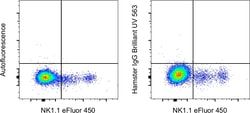

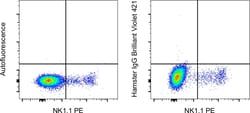
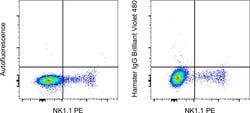
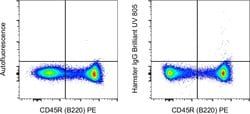
Description
- The isotype of a primary antibody and the application it is being used in can result in background staining
- Primary antibody background noise can be caused by binding to Fc receptors on target cells; by non-specific interactions with cellular proteins, carbohydrates, and lipids; or by cell autofluorescence
- Isotype control antibodies can act as negative controls to help differentiate non-specific background signal from specific antibody signal because they have no relevant specificity to a target antigen
- While isotype controls are most commonly used in flow cytometry, they are useful in other applications such as chromatin immunoprecipitation (ChIP), immunohistochemistry, and gel shifts
- Isotype controls should match with the primary antibody species and isotype so that the level of specific staining by the primary antibody may be accurately determined
- If using directly labeled primary antibodies, the isotype control works best if conjugated with the same label as the test antibody.