36-847-1481
Mouse IgG1 kappa Isotype Control (P3.6.2.8.1), Brilliant Ultra Violet™ 805, eBioscience™, Invitrogen™
Manufacturer: Invitrogen
Select a Size
| Pack Size | SKU | Availability | Price |
|---|---|---|---|
| Each | 36-847-1481-Each | In Stock | ₹ 24,532.85 |
36-847-1481 - Each
In Stock
Quantity
1
Base Price: ₹ 24,532.85
GST (18%): ₹ 4,415.913
Total Price: ₹ 28,948.763
Antigen
Mouse IgG1 kappa
Classification
Monoclonal
Formulation
PBS with BSA and 0.09% sodium azide; pH 7.2
Host Species
Mouse
Quantity
50 μg
Primary or Secondary
Isotype Control (Primary)
Content And Storage
4° C, store in dark, DO NOT FREEZE!
Isotype
IgG1 κ
Applications
Control, Flow Cytometry
Clone
P3.6.2.8.1
Gene Alias
IgG1; Igh-4; Ighg1; Immunoglobulin G; Immunoglobulin G1; immunoglobulin heavy constant gamma 1 (G1m marker); ImmunoglobulinG; ImmunoglobulinG1; VH7183
Purification Method
Affinity chromatography
Regulatory Status
RUO
Target Species
None
Form
Liquid
Related Products


Description
- The monoclonal mouse IgG1 kappa immunoglobulin is useful as an isotype control
- Applications Reported: This P3.6.2.8.1 antibody has been reported for use in flow cytometric analysis
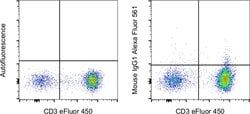
- Applications Tested: This P3.6.2.8.1 antibody has been tested by flow cytometric analysis of mouse splenocytes and normal human peripheral blood cells and should be used at the same concentration as the experimental antibody
- Brilliant Ultraviolet 805 is a tandem dye that emits at 797 nm and is intended for use on cytometers equipped with an ultraviolet (355 nm) laser
- Mouse IgG1 is a subtype of immunoglobulin G antibody that is produced by B cells in response to an antigen
- It is the most abundant IgG subtype in the serum and plays a crucial role in the adaptive immune response
- Mouse IgG1 is composed of two heavy chains and two light chains, and it is involved in opsonization, complement activation, and antibody-dependent cell-mediated cytotoxicity
- It is also involved in the regulation of immune responses, including the activation of T cells and the inhibition of B cell activation
- Mouse IgG1 is widely used in research and diagnostic applications, including ELISA, Western blotting, and immunohistochemistry
- It is also used in therapeutic applications, such as immunotherapy and vaccine development.