TLR2 Polyclonal Antibody, Invitrogen™
Manufacturer: Thermo Scientific
Select a Size
| Pack Size | SKU | Availability | Price |
|---|---|---|---|
| Each of 1 | 01-675-308-Each-of-1 | In Stock | ₹ 47,036.50 |
01-675-308 - Each of 1
In Stock
Quantity
1
Base Price: ₹ 47,036.50
GST (18%): ₹ 8,466.57
Total Price: ₹ 55,503.07
Antigen
TLR2
Classification
Polyclonal
Conjugate
Unconjugated
Gene
Tlr2
Gene Alias
CD282; Ly105; TIL4; Tlr2; TLR-2; toll like receptor 2; toll/interleukin-1 receptor-like protein 4; Toll-like receptor; toll-like receptor 2; toll-like receptor 2 variant 1; toll-like receptor 2 variant 2; toll-like-receptor 2, exon 1a_; Toll-like-receptor, exon 1b; Toll-like-receptor, exon 1b_; Toll-like-receptor2, exon 1a
Host Species
Rabbit
Purification Method
Protein G
Regulatory Status
RUO
Gene ID (Entrez)
24088, 7097
Content And Storage
-20° C, Avoid Freeze/Thaw Cycles
Form
Liquid
Applications
Immunohistochemistry, Western Blot
Concentration
0.5 mg/mL
Formulation
PBS with no preservative
Gene Accession No.
O60603, Q9QUN7
Gene Symbols
Tlr2
Immunogen
Synthetic peptides corresponding to residues 180-196, 353-370, and 473-489 of human TLR2.
Quantity
100 μg
Primary or Secondary
Primary
Target Species
Human, Mouse
Product Type
Antibody
Isotype
IgG
Related Products




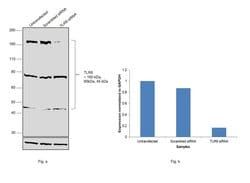

Description
- TLR2 is a member of the Toll-like receptor (TLR) family which play a fundamental role in pathogen recognition and activation of innate immunity
- TLR proteins act through adaptor molecules such as MyD88 and TIRAP to activate various kinases and transcription factors such as Protein Kinase C (PKC) alpha/beta and NF-kappa-B
- TLR2 can form heterodimers with either TLR1 or TLR6, and as a heterodimer, can recognize a variety of bacterial and mycoplasma lipoproteins respectively
- TLRs are highly conserved from Drosophila to humans and share structural and functional similarities
- The various TLRs exhibit different patterns of expression
- TLR2 is expressed most abundantly in peripheral blood leukocytes, and mediates host response to Gram-positive bacteria and yeast via stimulation of NF-kappaB
- TLR2 aids in the recognition of pathogen-associated molecular patterns (PAMPs) that are expressed on infectious agents, and mediate the production of cytokines necessary for the development of effective immunity
- Ten human homologs of TLRs (TLR1-10) have been described
- TLR2 is expressed in human cells such as tonsils, microglia, lymph nodes, and appendices, activated B-cells in germinal centers
- CD14+ monocytes express the highest level of TLR2 followed by CD15+ granulocytes, CD19+ B-cells, and CD3+ T-cells
- The expression of TLR2 on different cell types are regulated by different immune response modifiers
- For example, LPS, GM-CSF, IL-1, and IL-10 up regulates TLR2 whereas IL-4, IFN-gamma, and TNF down regulate TLR2 expression in monocytes.