CD30 Monoclonal Antibody (MEM-268), Invitrogen™
Manufacturer: Thermo Scientific
Select a Size
| Pack Size | SKU | Availability | Price |
|---|---|---|---|
| Each of 1 | 01-676-160-Each-of-1 | In Stock | ₹ 38,982.00 |
01-676-160 - Each of 1
In Stock
Quantity
1
Base Price: ₹ 38,982.00
GST (18%): ₹ 7,016.76
Total Price: ₹ 45,998.76
Antigen
CD30
Classification
Monoclonal
Concentration
1 mg/mL
Formulation
PBS with 15mM sodium azide; pH 7.4
Gene Accession No.
P28908
Gene Symbols
TNFRSF8
Immunogen
Expression vector containing CD30 cDNA (booster suspension of THP-1 cell line).
Quantity
100 μg
Primary or Secondary
Primary
Target Species
Human
Product Type
Antibody
Isotype
IgG
Applications
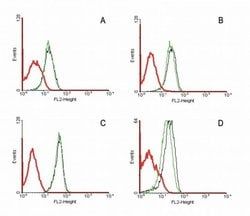
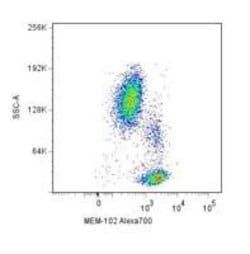
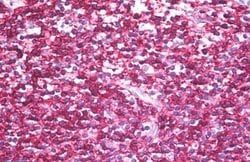
Flow Cytometry, Immunohistochemistry (Paraffin)
Clone
MEM-268
Conjugate
Unconjugated
Gene
TNFRSF8
Gene Alias
Ber-H2; Cd30; CD30 antigen; CD30 molecule; CD30L receptor; cytokine receptor CD30; D1S166E; Ki; Ki-1; Ki-1 antigen; Lymphocyte activation antigen CD30; sCD30; soluble CD30; TNF receptor superfamily member 8; TNFRSF8; Tumor necrosis factor receptor superfamily member 8; tumor necrosis factor receptor superfamily, member 8; Tumor necrosis factor superfamily member 8; tumor necrosis factor superfamily, member CD30
Host Species
Mouse
Purification Method
Protein A
Regulatory Status
RUO
Gene ID (Entrez)
943
Content And Storage
4° C, do not freeze
Form
Liquid
Related Products



Description
- CD30 (Ki-1, TNF Receptor Superfamily Member 8) is a type I transmembrane glycoprotein of the TNF receptor superfamily
- CD30 was originally identified as a cell surface antigen of Hodgkins and Reed-Sternberg cells using monoclonal antibody Ki-1
- The ligand for CD30 is CD30L (CD153)
- The binding of CD30 to CD30L mediates pleiotropic effects including cell proliferation, activation, differentiation, and apoptotic cell death
- CD30 has a critical role in the pathophysiology of Hodgkin's disease and other CD30+ lymphomas
- CD30 acts as a costimulatory molecule in thymic negative selection
- In addition to its expression on Hodgkin's and Reed-Sternberg cells, CD30 is also found in some non-Hodgkin's lymphomas (including Burkitt's lymphomas), virus-infected T and B cells, and on normal T and B cells after activation
- In T cells, CD30 expression is present on a subset of T cells that produce Th2-type cytokines and on CD4+/CD8+ thymocytes that co-express CD45RO and the IL4 receptor
- Soluble form of CD30 (sCD30) serves as a marker reflecting Th2 immune response
- TRAF2 and TRAF5 can interact with this receptor, and mediate the signal transduction that leads to the activation of NF-kappaB
- CD30 is a positive regulator of apoptosis, and has been shown to limit the proliferative potential of autoreactive CD8 effector T cells and protect the body against autoimmunity
- Two alternatively spliced transcript variants of this gene encoding distinct isoforms have been reported
- CD30 is expressed by mononuclear cells in Hodgkin's lymphoma, Reed Sternberg cells and most Anaplastic Large Cell Lymphomas (ALCL)
- CD30 is also expressed by embryonal carcinomas.