01-676-673
Anthrax Protective Antigen Polyclonal Antibody, Invitrogen™
Manufacturer: Thermo Scientific
Select a Size
| Pack Size | SKU | Availability | Price |
|---|---|---|---|
| Each of 1 | 01-676-673-Each-of-1 | In Stock | ₹ 46,502.50 |
01-676-673 - Each of 1
In Stock
Quantity
1
Base Price: ₹ 46,502.50
GST (18%): ₹ 8,370.45
Total Price: ₹ 54,872.95
Antigen
Anthrax Protective Antigen
Classification
Polyclonal
Conjugate
Unconjugated
Gene Alias
Anthrax PA
Immunogen
Synthetic peptide corresponding to residues 240-254 of the anthrax Pa protein.
Regulatory Status
RUO
Target Species
Bacteria
Product Type
Antibody
Isotype
IgG
Applications
Western Blot
Concentration
Conc. Not Determined
Formulation
whole serum diluted in PBS with 0.05% BSA and 0.05% sodium azide
Host Species
Rabbit
Quantity
200 μL
Primary or Secondary
Primary
Content And Storage
Store at 4°C short term. For long term storage, store at -20°C, avoiding freeze/thaw cycles.
Form
Liquid
Related Products



Description
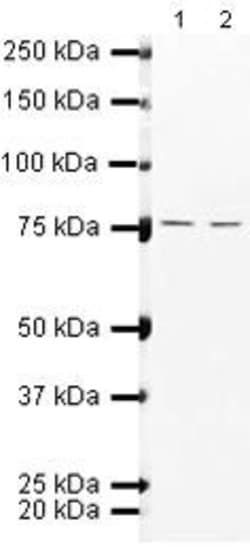
- Suggested positive control: PA recombinant protein
- Anthrax infection is initiated by the inhalation, ingestion, or cutaneous contact with Bacillus anthracis endospores
- B
- anthracis produces three polypeptides that comprise the anthrax toxin: protective antigen (PA), lethal factor (LF), and edema factor (EF)
- PA binds to two related proteins on the cell surface; these are termed tumor epithelial marker 8 (TEM8)/anthrax toxin receptor (ATR) and capillary morphogenesis protein 2 (CMG2), although it is still unclear which is physiologically relevant
- Following PA binding to its receptor, PA is cleaved into two fragments by a furin-like protease
- The bound fragment binds both LF and EF; the resulting complex is then endocytosed which allows the translocation of LF and EF into the cytoplasm
- These toxins are usually sufficient to cause rapid cell death, and often the death of the organism.