01-676-933
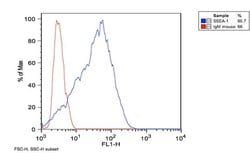
SSEA1 Monoclonal Antibody (BRA4F1), Invitrogen™
Manufacturer: Thermo Scientific
Select a Size
| Pack Size | SKU | Availability | Price |
|---|---|---|---|
| Each of 1 | 01-676-933-Each-of-1 | In Stock | ₹ 49,884.50 |
01-676-933 - Each of 1
In Stock
Quantity
1
Base Price: ₹ 49,884.50
GST (18%): ₹ 8,979.21
Total Price: ₹ 58,863.71
Antigen
SSEA1
Classification
Monoclonal
Concentration
0.1 mg/mL
Formulation
PBS with 0.02% sodium azide
Gene Accession No.
P22083
Gene Symbols
FUT4
Immunogen
Erythroid-myeloid leukemia cell line K562.
Quantity
100 μg
Primary or Secondary
Primary
Target Species
Human
Product Type
Antibody
Isotype
IgG2b κ
Applications
ELISA, Flow Cytometry, Immunohistochemistry (Frozen), Immunohistochemistry (Paraffin)
Clone
BRA4F1
Conjugate
Unconjugated
Gene
FUT4
Gene Alias
FUTIV, Lewis X, SSEA-1
Host Species
Mouse
Purification Method
purified
Regulatory Status
RUO
Gene ID (Entrez)
2526
Content And Storage
4° C
Form
Liquid
Related Products


Description
- CD15 (Lewis X, Le(x); stage specific embryonic antigen-1, SSEA-1) is a trisacharide determinant (3-fucosyl-N-acetyllactosamine) expressed on several glycolipids, glycoproteins and proteoglycans of various cell types, e.g
- granulocytes, mast cells, monocytes, macrophages, cells of gastric mucosa, nervous system or various tumour cells
- There are several variants of Lewis x, such as sialyl-Lewis x or sulphated Lewis x
- Cells with high surface expression of Le(x) antigen exhibit strong self-aggregation, based on calcium-dependent Le(x)-Le(x) interaction
- This process is involved for example in embryo compaction or in autoaggregation of teratocarcinoma cells
- Sialyl-Le(x) and its isomer sialyl-Le(a) are ligands of selectins
- CD15 expression has been extensively used to confirm diagnosis of Hodgkin's disease.