CD183 (CXCR3) Monoclonal Antibody (CXCR3-173), FITC, eBioscience™, Invitrogen™
Manufacturer: Fischer Scientific
Select a Size
| Pack Size | SKU | Availability | Price |
|---|---|---|---|
| Each of 1 | 11-183-180-Each-of-1 | In Stock | ₹ 11,392.00 |
11-183-180 - Each of 1
In Stock
Quantity
1
Base Price: ₹ 11,392.00
GST (18%): ₹ 2,050.56
Total Price: ₹ 13,442.56
Antigen
CD183 (CXCR3)
Classification
Monoclonal
Concentration
0.5 mg/mL
Formulation
PBS with 0.09% sodium azide; pH 7.2
Gene Accession No.
O88410
Gene Symbols
CXCR3
Purification Method
Affinity chromatography
Regulatory Status
RUO
Gene ID (Entrez)
12766
Content And Storage
4° C, store in dark, DO NOT FREEZE!
Form
Liquid
Applications
Flow Cytometry
Clone
CXCR3-173
Conjugate
FITC
Gene
CXCR3
Gene Alias
an; C Cmotif chemokine; C X C motif chemokine; CC motif chemokine; CCmotif chemokine; CD182; CD183; chemokine (C-X-C motif) receptor 3; chemokine receptor 3; CKR-L2; Cmkar3; CXC; C-X-C chemokine receptor type 3; CXC motif chemokine; C-X-C motif chemokine receptor 3; Cxcr3; CXC-R3; CXCR-3; G protein-coupled receptor 9; GPR9; Interferon-inducible protein 10 receptor; IP10; IP10 receptor; IP-10 receptor; IP10-R; Mig receptor; MigR; Mig-R
Host Species
Armenian Hamster
Quantity
25 μg
Primary or Secondary
Primary
Target Species
Mouse
Product Type
Antibody
Isotype
IgG
Related Products
Description
- Description: The monoclonal antibody CXCR3-173 recognizes mouse CD183 also known as CXCR3
- CD183 is a seven transmembrane G-protein liked chemokine receptor which binds three ligands; CXCL9 (mig), CXCL10 (IP-10)and CXCL11 (ITAC)
- CD183 as been shown to play a role in CD4 T cell responses to grafts
- CXCR3 knockout mice have compromised allograft rejection responses
- Expression is found on NK cells, a subset of T lymphocytes and a subset of Tregs as well as preferential expression on Th1-polarized cells
- The antibody CXCR3-173 has been shown to affect chemotaxis in response to ligand
- The presence of ligand eliminates staining with the antibody
- In vivo addition of the antibody delays cardiac and pancreatic islet allograft rejection
- Applications Reported: This CXCR3-173 antibody has been reported for use in flow cytometric analysis
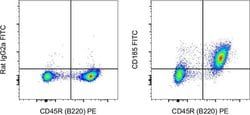
- Applications Tested: This CXCR3-173 antibody has been tested by flow cytometric analysis of mouse splenocytes
- This can be used at less than or equal to 0.25 μg per test
- A test is defined as the amount (μg) of antibody that will stain a cell sample in a final volume of 100 μL
- Cell number should be determined empirically but can range from 10^5 to 10^8 cells/test
- It is recommended that the antibody be carefully titrated for optimal performance in the assay of interest
- Excitation: 488 nm; Emission: 520 nm; Laser: Blue Laser
- Filtration: 0.2 μm post-manufacturing filtered
- This gene encodes a G protein-coupled receptor with selectivity for three chemokines, termed IP10 (interferon-g-inducible 10 kDa protein), Mig (monokine induced by interferon-g) and I-TAC (interferon-inducible T cell a-chemoattractant)
- IP10, Mig and I-TAC belong to the structural subfamily of CXC chemokines, in which a single amino acid residue separates the first two of four highly conserved Cys residues
- Binding of chemokines to this protein induces cellular responses that are involved in leukocyte traffic, most notably integrin activation, cytoskeletal changes and chemotactic migration
- Inhibition by Bordetella pertussis toxin suggests that heterotrimeric G protein of the Gi-subclass couple to this protein
- Signal transduction has not been further analyzed but may include the same enzymes that were identified in the signaling cascade induced by other chemokine receptors
- As a consequence of chemokine-induced cellular desensitization (phosphorylation-dependent receptor internalization), cellular responses are typically rapid and short in duration
- Cellular responsiveness is restored after dephosphorylation of intracellular receptors and subsequent recycling to the cell surface
- This gene is prominently expressed in in vitro cultured effector/memory T cells, and in T cells present in many types of inflamed tissues
- In addition, IP10, Mig and I-TAC are commonly produced by local cells in inflammatory lesion, suggesting that this gene and its chemokines participate in the recruitment of inflammatory cells
- Therefore, this protein is a target for the development of small molecular weight antagonists, which may be used in the treatment of diverse inflammatory diseases
- Multiple transcript variants encoding different isoforms have been found for this gene.