CD63 Monoclonal Antibody (NVG-2), PE, eBioscience™, Invitrogen™
Manufacturer: Fischer Scientific
Select a Size
| Pack Size | SKU | Availability | Price |
|---|---|---|---|
| Each of 1 | 12-063-182-Each-of-1 | In Stock | ₹ 30,260.00 |
12-063-182 - Each of 1
In Stock
Quantity
1
Base Price: ₹ 30,260.00
GST (18%): ₹ 5,446.80
Total Price: ₹ 35,706.80
Antigen
CD63
Classification
Monoclonal
Concentration
0.2 mg/mL
Formulation
PBS with 0.09% sodium azide; pH 7.2
Gene Accession No.
P41731
Gene Symbols
CD63
Purification Method
Affinity chromatography
Regulatory Status
RUO
Gene ID (Entrez)
12512
Content And Storage
4° C, store in dark, DO NOT FREEZE!
Form
Liquid
Applications
Flow Cytometry
Clone
NVG-2
Conjugate
PE
Gene
CD63
Gene Alias
C75951; CD 63; Cd63; CD63 antigen; CD63 antigen (melanoma 1 antigen); Cd63 molecule; CD63 protein; granulophysin; LAMP-3; Lysosomal-associated membrane protein 3; lysosome-associated membrane glycoprotein 3; mast cell antigen AD1; ME491; melanoma 1 antigen; melanoma-associated antigen ME491; melanoma-associated antigen MLA1; MLA1; Ocular melanoma-associated antigen; OMA81H; Tetraspanin-30; TSPAN30; tspan-30
Host Species
Rat
Quantity
100 μg
Primary or Secondary
Primary
Target Species
Mouse
Product Type
Antibody
Isotype
IgG2a κ
Related Products
Description
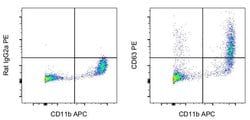
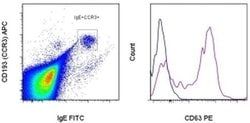
- Rat Monoclonal Antibody CD63 (LAMP-3, lysosome-associated membrane protein-3), a glycoprotein of tetraspanin family, is present in late endosomes, lysosomes and secretory vesicles of various cell types
- CD63 is also present in the plasma membrane, usually following cell activation
- Hence, CD63 has become a widely used basophil activation marker
- In mast cells, however, CD63 exposition does not need their activation
- CD63 interacts with integrins and affects phagocytosis and cell migration, it is also involved in H/K-ATPase trafficking regulation of ROMK1 channels
- CD63 also serves as a T-cell costimulation molecule
- Expression of CD63 can be used for predicting the prognosis in earlier stages of carcinomas
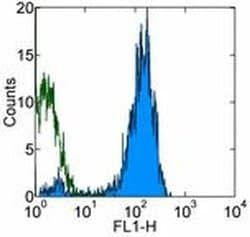
- CD63 is expressed on activated platelets, and is a lysosomal membrane glycoprotein that is translocated to plasma membrane after platelet activation
- CD63 is also present in monocytes and macrophages and is weakly expressed on granulocytes, B, and T cells
- CD63 is identical to the melanoma-associated antigen which is ME491 and to the platelet antigen PTLGP40
- Diseases associated with CD63 dysfunction include melanoma and Hermansky-Pudlak Syndrome.