CD115 (c-fms) Monoclonal Antibody (12-3A3-1B10), PE, eBioscience™, Invitrogen™
Manufacturer: Invitrogen
Select a Size
| Pack Size | SKU | Availability | Price |
|---|---|---|---|
| Each | 12-115-941-Each | In Stock | ₹ 14,208.85 |
12-115-941 - Each
In Stock
Quantity
1
Base Price: ₹ 14,208.85
GST (18%): ₹ 2,557.593
Total Price: ₹ 16,766.443
Antigen
CD115 (c-fms)
Classification
Monoclonal
Concentration
5 μL/Test
Formulation
PBS with 0.2% BSA and 0.09% sodium azide; pH 7.2
Gene Accession No.
P07333
Gene Symbols
Csf1r
Purification Method
Affinity chromatography
Regulatory Status
RUO
Gene ID (Entrez)
1436
Content And Storage
4° C, store in dark, DO NOT FREEZE!
Form
Liquid
Applications
Flow Cytometry
Clone
12-3A3-1B10
Conjugate
PE
Gene
Csf1r
Gene Alias
AI323359; CD115; CD115 antigen; C-FMS; colony stimulating factor 1 receptor; colony stimulating factor 1 receptor, formerly McDonough feline sarcoma viral (v-fms) oncogene homolog; CSF-1 receptor; CSF1R; CSF-1R; CSF-1-R; CSFIR; Csfmr; CSFR; EC 2.7.10.1; FIM2; Fim-2; FMS; fms proto-oncogene; HDLS; kinase CSFR; macrophage colony stimulating factor I receptor; macrophage colony-stimulating factor 1 receptor; McDonough feline sarcoma viral (v-fms) oncogene homolog; M-CSFR; M-CSF-R; mrfms; OTTHUMP00000224093; protein-tyrosine kinase; proto-oncogene c-Fms; proto-oncogene fms
Host Species
Rat
Quantity
25 Tests
Primary or Secondary
Primary
Target Species
Human
Product Type
Antibody
Isotype
IgG2a κ
Related Products
Description
- Description: CD115 or Colony-Stimulating Factor-1 Receptor (CSF-1R) is expressed on cells committed to the monocyte lineage and osteoclasts
- CSF-1R is a disulfide-linked homodimer, which upon binding of its ligand, CSF-1, undergoes tyrosine autophosphorylation and subsequently, phosphorylates other membrane-proximal downstream targets which results in cytoskeletal remodeling, gene transcription and protein translation
- CSF-1R activation promotes the survival, proliferation and differentiation of mononuclear phagocytes and the spreading and motility of macrophages
- In osteoclasts, CSF-1R synergizes with RANKL to regulate the differentiation of mononuclear phagocytes to osteoclasts
- Applications Reported: This 12-3A3-1B10 antibody has been reported for use in flow cytometric analysis
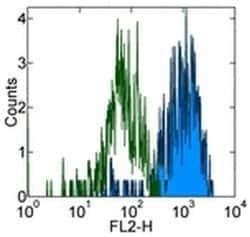
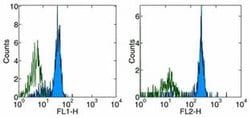
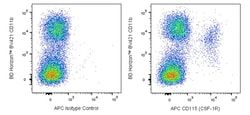
- Applications Tested: This 12-3A3-1B10 antibody has been pre-titrated and tested by flow cytometric analysis of normal human peripheral blood
- This can be used at 5 μL (0.03 μg) per test
- A test is defined as the amount (μg) of antibody that will stain a cell sample in a final volume of 100 μL
- Cell number should be determined empirically but can range from 10^5 to 10^8 cells/test
- Excitation: 488-561 nm; Emission: 578 nm; Laser: Blue Laser, Green Laser, Yellow-Green Laser
- Filtration: 0.2 μm post-manufacturing filtered
- CSF1R (FMS) is involved in the production, differentiation, and function of macrophages, and is implicated in promyelocytic leukemias
- Ligand binding activates the receptor kinase through a process of oligomerization and transphosphorylation
- CSF1R is a tyrosine kinase transmembrane receptor and member of the CSF1/PDGF receptor family of tyrosine-protein kinases
- Mutations in the gene encoding CSF1R have been associated with a predisposition to myeloid malignancy.Tyrosine-protein kinase that acts as cell-surface receptor for CSF1 and IL34 and plays an essential role in the regulation of survival, proliferation and differentiation of hematopoietic precursor cells, especially mononuclear phagocytes, such as macrophages and monocytes
- Promotes the release of proinflammatory chemokines in response to IL34 and CSF1, and plays an important role in innate immunity and in inflammatory processes
- The first intron of the CSF1R gene contains a transcriptionally inactive ribosomal protein L7 processed pseudogene oriented in the opposite direction
- Mutations in the CSF1R gene have been associated with a predisposition to myeloid malignancy.