CD133 (Prominin-1) Monoclonal Antibody (13A4), eBioscience™, Invitrogen™
Manufacturer: Invitrogen
Select a Size
| Pack Size | SKU | Availability | Price |
|---|---|---|---|
| Each of 1 | 14-133-137-Each-of-1 | In Stock | ₹ 1,22,108.00 |
14-133-137 - Each of 1
In Stock
Quantity
1
Base Price: ₹ 1,22,108.00
GST (18%): ₹ 21,979.44
Total Price: ₹ 1,44,087.44
Antigen
CD133 (Prominin-1)
Classification
Monoclonal
Concentration
0.5 mg/mL
Formulation
PBS with 0.09% sodium azide; pH 7.2
Gene Accession No.
O54990
Gene Symbols
PROM1
Purification Method
Affinity chromatography
Regulatory Status
RUO
Gene ID (Entrez)
19126, 488816
Content And Storage
4° C
Form
Liquid
Applications
Flow Cytometry, Immunohistochemistry (Frozen), Immunoprecipitation, Western Blot
Clone
13A4
Conjugate
Unconjugated
Gene
PROM1
Gene Alias
4932416E19Rik; AC133; Antigen AC133; antigen AC133 homolog; antigen CD133; CD107b; CD133; CORD12; fudenine; hematopoietic stem cell antigen; hProminin; Lamp II; Lamp2; LAMP-2; Lamp-2a; Lamp-2b; Lamp-2c; LGP-96; LGP-B; Mac3; MCDR2; MSTP061; Prom; PROM1; Prom-1; prominin 1; prominin 1.s1; Prominin1; prominin-1; prominin-1.s2; prominin-like 1; prominin-like protein 1; PROML1; RP41; STGD4
Host Species
Rat
Quantity
2 mg
Primary or Secondary
Primary
Target Species
Canine, Mouse
Product Type
Antibody
Isotype
IgG1 κ
Related Products

Description
- The 13A4 MAb recognizes mouse Prominin-1 (sometimes referred to as CD133 and, in the case of human orthologue, as AC133), a 115-120 kDa pentaspan transmembrane (5-TM) domain glycoprotein
- Prominin-1 is expressed on primitive cells such as hematopoietic stem and progenitor cells, neural and endothelial stem cells, retina and retinoblastoma, as well as developing epithelium
- To date, the function and ligand of Prominin-1 are unknown
- The 13A4 antibody does not cross react with rat, human, chicken, or Drosophila antigen but has been reported to work in canine/dog
- Applications Reported: The 13A4 antibody has been reported for use in flow cytometric analysis (∽0.25-1 μg/million cells), immunoprecipitation (∽10-25 μg/mL), immunoblotting (WB) (∽1-5 μg/mL), and immunohistochemical staining (∽1-10 μg/mL)
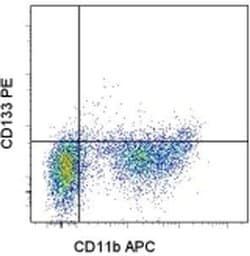
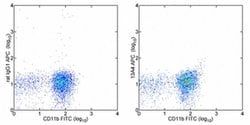
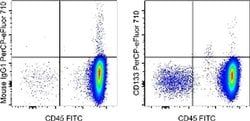
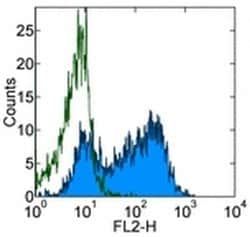
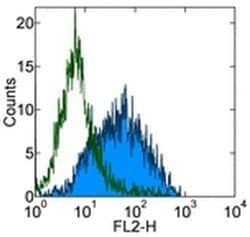
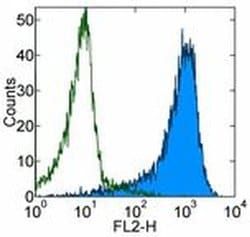
- Applications Tested: The 13A4 antibody has been tested by flow cytometric analysis of mouse bone marrow cells
- This can be used at less than or equal to 1 μg per test
- A test is defined as the amount (μg) of antibody that will stain a cell sample in a final volume of 100 μL
- Cell number should be determined empirically but can range from 10^5 to 10^8 cells/test
- It is recommended that the antibody be carefully titrated for optimal performance in the assay of interest
- Purity: Greater than 90%, as determined by SDS-PAGE
- Aggregation: Less than 10%, as determined by HPLC
- Filtration: 0.2 μm post-manufacturing filtered
- The CD133 (AC133) antigen is a 97 kDa glycoprotein, with 5 transmembrane domains, that shows up as a 120 kDa band on protein gels due to glycosylation
- CD133 is a cell surface marker expressed by immature hematopoietic stem cells but not mature blood cells
- In addition to hematopoietic stem and progenitor cells, CD133 has been found to be a marker for other stem and progenitor cells including neural and embryonic stem cells
- CD133 has been shown to be expressed in cancers, including some leukemias and brain tumors, that may be derived from stem cells
- Low level expression could also be detected in the kidney, pancreas, placenta, and fetal liver
- Mutations in this gene have been shown to result in retinitis pigmentosa and Stargardt disease
- Expression of the CD133 gene is also associated with several types of cancer
- CD133 is expressed from at least five alternative promoters that are expressed in a tissue-dependent manner, and multiple transcript variants encoding different isoforms have been found.