CD254 (RANK Ligand) Monoclonal Antibody (MIH24), eBioscience™, Invitrogen™
Manufacturer: Fischer Scientific
Select a Size
| Pack Size | SKU | Availability | Price |
|---|---|---|---|
| Each of 1 | 14-661-982-Each-of-1 | In Stock | ₹ 29,637.00 |
14-661-982 - Each of 1
In Stock
Quantity
1
Base Price: ₹ 29,637.00
GST (18%): ₹ 5,334.66
Total Price: ₹ 34,971.66
Antigen
CD254 (RANK Ligand)
Classification
Monoclonal
Concentration
0.5 mg/mL
Formulation
PBS with 0.09% sodium azide; pH 7.2
Gene Accession No.
O14788
Gene Symbols
TNFSF11
Purification Method
Affinity chromatography
Regulatory Status
RUO
Gene ID (Entrez)
8600
Content And Storage
4° C
Form
Liquid
Applications
ELISA, Flow Cytometry
Clone
MIH24
Conjugate
Unconjugated
Gene
TNFSF11
Gene Alias
CD254; H-RANK-L; hRANKL2; Ly109l; M-Rank-L; ODF; OPG; OPG ligand; OPGL; OPTB2; Osteoclast differentiation factor; osteoprotegerin ligand; Rankl; rank-l; receptor activator of NF-kappaB ligand; receptor activator of nuclear factor kappa B ligand; receptor activator of nuclear factor kappa-B ligand; RP11-86N24.2; sOdf; srankl; TNF-related activation-induced cytokine; Tnfsf11; TNLG6B; Trance; tumor necrosis factor (ligand) superfamily member 11; tumor necrosis factor (ligand) superfamily, member 11; tumor necrosis factor ligand 6B; tumor necrosis factor ligand superfamily member 11; Tumor necrosis factor ligand superfamily member 11, membrane form; Tumor necrosis factor ligand superfamily member 11, soluble form; tumor necrosis factor superfamily member 11; tumor necrosis factor-related activation-induced cytokine
Host Species
Mouse
Quantity
100 μg
Primary or Secondary
Primary
Target Species
Human
Product Type
Antibody
Isotype
IgG2b κ
Related Products

Description
- Description: The MIH24 monoclonal antibody reacts with human TRANCE (TNF-related activation-induced cytokine receptor) also known as RANKL (receptor activator of NF-kappaB ligand) and OPGL (Osteoprotegerin Ligand)
- TRANCE is a type II membrane protein with predicted molecular weight of 35 kDa
- Its extracellular domain is most closely related to TRAIL, FasL and TNF
- TRANCE mRNA is upregulated by TCR stimulation
- TRANCE-deficient mouse lacks osteoclasts
- In addition, TRANCE has been shown to be involved in the interactions between T-dendritic and T-B cells
- It was also found to be critical in osteoclast differentiation
- The TRANCE-RANK interaction regulates the expression of the anti-apoptotic molecule Bcl-xL
- Applications Reported: The MIH24 antibody has been reported for use in flow cytometric analysis, and ELISA
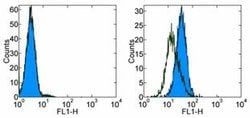
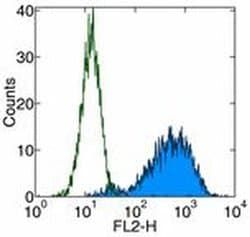
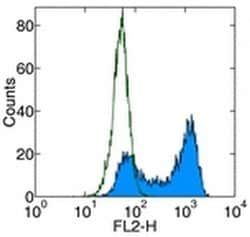
- Applications Tested: The MIH24 antibody has been tested by flow cytometric analysis of human RANKL transfected cells
- This can be used at less than or equal to 1 μg per test
- A test is defined as the amount (μg) of antibody that will stain a cell sample in a final volume of 100 μL
- Cell number should be determined empirically but can range from 10^5 to 10^8 cells/test
- It is recommended that the antibody be carefully titrated for optimal performance in the assay of interest
- Purity: Greater than 90%, as determined by SDS-PAGE
- Aggregation: Less than 10%, as determined by HPLC
- Filtration: 0.2 μm post-manufacturing filtered
- This gene encodes a member of the tumor necrosis factor (TNF) cytokine family which is a ligand for osteoprotegerin and functions as a key factor for osteoclast differentiation and activation
- This protein was shown to be a dentritic cell survival factor and is involved in the regulation of T cell-dependent immune response
- T cell activation was reported to induce expression of this gene and lead to an increase of osteoclastogenesis and bone loss
- This protein was shown to activate antiapoptotic kinase AKT/PKB through a signaling complex involving SRC kinase and tumor necrosis factor receptor-associated factor (TRAF) 6, which indicated this protein may have a role in the regulation of cell apoptosis
- Targeted disruption of the related gene in mice led to severe osteopetrosis and a lack of osteoclasts
- The deficient mice exhibited defects in early differentiation of T and B lymphocytes, and failed to form lobulo-alveolar mammary structures during pregnancy
- Two alternatively spliced transcript variants have been found.