CD326 (EpCAM) Monoclonal Antibody (1B7), eBioscience™, Invitrogen™
Manufacturer: Fischer Scientific
Select a Size
| Pack Size | SKU | Availability | Price |
|---|---|---|---|
| Each of 1 | 14-932-695-Each-of-1 | In Stock | ₹ 3,06,605.00 |
14-932-695 - Each of 1
In Stock
Quantity
1
Base Price: ₹ 3,06,605.00
GST (18%): ₹ 55,188.90
Total Price: ₹ 3,61,793.90
Antigen
CD326 (EpCAM)
Classification
Monoclonal
Concentration
0.5 mg/mL
Formulation
PBS with 0.09% sodium azide; pH 7.2
Gene Accession No.
P16422
Gene Symbols
EPCAM
Purification Method
Affinity chromatography
Regulatory Status
RUO
Gene ID (Entrez)
4072
Content And Storage
4° C
Form
Liquid
Applications
Flow Cytometry, Immunocytochemistry, Immunohistochemistry (Frozen), Immunohistochemistry (Paraffin), Immunoprecipitation, Western Blot
Clone
1B7
Conjugate
Unconjugated
Gene
EPCAM
Gene Alias
adenocarcinoma-associated antigen; CD326; cell surface glycoprotein Trop-1; DIAR5; EGP; EGP-2; EGP314; EGP40; EPCAM; Ep-CAM; EpCAM1; epithelial cell adhesion molecule; Epithelial cell surface antigen; Epithelial glycoprotein; Epithelial glycoprotein 314; ESA; GA733-2; gp40; hEGP314; HNPCC8; human epithelial glycoprotein-2; KS 1/4 antigen; KS1/4; KSA; Ly74; lymphocyte antigen 74; M1S2; M4S1; major gastrointestinal tumor-associated protein GA733-2; mEGP314; membrane component, chromosome 4, surface marker (35kD glycoprotein); MIC18; MK-1; panepithelial glycoprotein 314; protein 289A; Protein D5.7A; Tacsd1; Tacstd1; TROP1; Trop-1 protein; Tumor-associated calcium signal transducer 1
Host Species
Mouse
Quantity
10 mg
Primary or Secondary
Primary
Target Species
Human
Product Type
Antibody
Isotype
IgG1 κ
Related Products
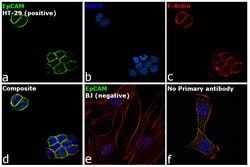
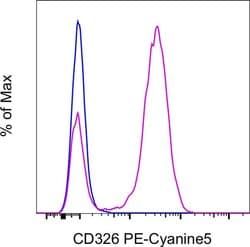
Description
- EpCAM (Epithelial cell adhesion molecule, CD326, KSA, TROP1) is a 40 kD cell-surface adhesion molecule participating in homophilic, calcium-independent cell-cell interactions
- EpCAM is a type-I transmembrane protein, and is expressed primarily on the basolateral surface of most epithelia
- Although normal epithelia express low levels of EpCAM, increased expression has been correlated with increased proliferation and progression to a mesenchymal phenotype
- EpCAM has also been used as a diagnostic marker on circulating metastatic carcinoma cells, while cancer cells of non-epithelial origin do not express EpCAM
- Ep-CAM (epithelial adhesion molecule, epithelial specific antigen, ESA) is a transmembrane glycoprotein expressed in the epithelium with a molecular weight of approximately 40 kDa, which functions as an epithelial cell adhesion molecule
- Ep-CAM functions as a homotypic calcium-independent cell adhesion molecule, and has a direct impact on cell cycle, proliferation and metabolism of epithelial cells and fibroblasts due to its ability to rapidly induce the proto-oncogene c-myc and the cell cycle regulating genes cyclin A and E
- Ep-CAM mediates Ca2+-independent homotypic interactions
- Formation of Ep-CAM-mediated adhesions have a negative regulatory effect on adhesions mediated by classic cadherins, which may have strong effects on the differentiation and growth of epithelial cells
- Ep-CAM overexpression was suggested to be associated with enhanced epithelial proliferation
- Ep-CAM is highly expressed in human carcinomas, and is a marker for tumors of epithelial lineage
- Ep-CAM is expressed on baso-lateral cell surface in most simple epithelia and many carcinoma types
- Also, Ep-CAM reportedly distinguishes adenocarcinomas from pleural mesotheliomas.