200020112
GP6 Polyclonal Antibody, Invitrogen™
Rabbit Polyclonal Antibody
Manufacturer: Fischer Scientific
The price for this product is unavailable. Please request a quote
Antigen
GP6
Applications
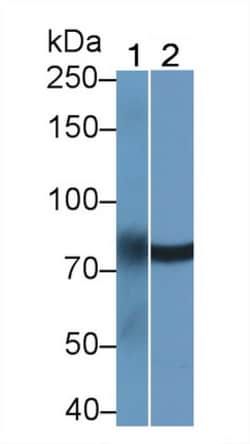
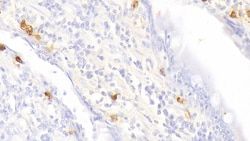
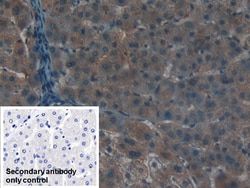
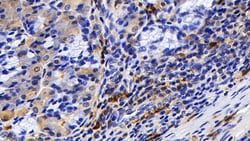
Immunocytochemistry, Immunohistochemistry (Paraffin), Western Blot
Conjugate
Unconjugated
Host Species
Rabbit
Target Species
Human, Porcine
Gene Accession No.
Q9HCN6
Gene ID (Entrez)
100517829, 51206
Immunogen
Recombinant Human GP6 protein, Tyr86-Thr231 (Accession #Q9HCN6)
Primary or Secondary
Primary
Content And Storage
Store at 4°C short term. For long term storage, store at -20°C, avoiding freeze/thaw cycles.
Concentration
0.5 mg/mL
Classification
Polyclonal
Form
Liquid
Regulatory Status
RUO
Formulation
PBS with 50% glycerol and 0.05% Proclin 300, pH 7.4
Gene Alias
9830166G18Rik, BDPLT11, Glycoprotein 5, glycoprotein 6, glycoprotein 6 (platelet), glycoprotein VI (platelet), glycoprotein VI platelet, Gm469, GP6, GPIV, GPVI, platelet collagen receptor, platelet glycoprotein VI
Gene Symbols
GP6
Isotype
IgG
Purification Method
Protein A
Gene
GP6
Related Products
Description
- Glycoprotein VI (GP6) is a 58-kD platelet membrane glycoprotein that plays a crucial role in the collagen-induced activation and aggregation of platelets
- Upon injury to the vessel wall and subsequent damage to the endothelial lining, exposure of the subendothelial matrix to blood flow results in deposition of platelets
- Collagen fibers are the most thrombogenic macromolecular components of the extracellular matrix, with collagen types I, III, and VI being the major forms found in blood vessels
- Platelet interaction with collagen occurs as a 2-step procedure: (1) the initial adhesion to collagen is followed by (2) an activation step leading to platelet secretion, recruitment of additional platelets, and aggregation
- In physiologic conditions, the resulting platelet plug is the initial hemostatic event limiting blood loss
- However, exposure of collagen after rupture of atherosclerotic plaques is a major stimulus of thrombus formation associated with myocardial infarction or stroke.