CD244 Monoclonal Antibody (eBioC1.7 (C1.7)), PE-Cyanine5.5, eBioscience™, Invitrogen™
Manufacturer: eBioscience
Select a Size
| Pack Size | SKU | Availability | Price |
|---|---|---|---|
| Each of 1 | 35-583-842-Each-of-1 | In Stock | ₹ 32,574.00 |
35-583-842 - Each of 1
In Stock
Quantity
1
Base Price: ₹ 32,574.00
GST (18%): ₹ 5,863.32
Total Price: ₹ 38,437.32
Antigen
CD244
Classification
Monoclonal
Concentration
5 μL/Test
Formulation
PBS with 0.2% BSA and 0.09% sodium azide; pH 7.2
Gene Accession No.
Q9BZW8
Gene Symbols
CD244
Purification Method
Affinity chromatography
Regulatory Status
RUO
Gene ID (Entrez)
51744
Content And Storage
4° C, store in dark, DO NOT FREEZE!
Form
Liquid
Applications
Flow Cytometry
Clone
eBioC1.7 (C1.7)
Conjugate
PE-Cyanine5.5
Gene
CD244
Gene Alias
2B4; C9.1; CD244; CD244 long isoform; CD244 molecule; Cd244 molecule, natural killer cell receptor 2B4; CD244 natural killer cell receptor 2B4; CD244 short isoform; F730046O15Rik; h2B4; Ly90; NAIL; natural killer cell receptor 2B4; NK cell activation inducing ligand NAIL; NK cell activation-inducing ligand; NK cell receptor 2B4; NK cell type I receptor protein 2B4; NKR Nmrk; NKR2B4; Nmrk; non MHC restricted killing associated; non-MHC restricted killing associated; Signaling lymphocytic activation molecule 4; SLAM family member 4; SLAMF4; transmembrane NK cell receptor 2B4
Host Species
Mouse
Quantity
100 Tests
Primary or Secondary
Primary
Target Species
Human
Product Type
Antibody
Isotype
IgG1 κ
Related Products

Description
- Description: The eBioC1.7 monoclonal antibody reacts with human CD244 (2B4, p38)
- In human, CD244 is a 38 kDa protein expressed on NK cells, a subset of CD8+ T cells, gammadelta T cells, monocytes, basophils and eosinophils
- Binding of the CD244 ligand, CD48, results in NK cell activation, unlike mouse CD244, which is an inhibitory receptor
- For CD244 expressed on NK cells, binding of CD48 results in enhanced NK cell cytotoxicity and secretion of IFN-gamma
- Recently, it was demonstrated that binding of the C1.7 monoclonal antibody and CD48 involve the same residue in the V domain of human CD244, which explains the ability of C1.7 binding to induce activation of NK cells
- Binding of C1.7 to CD244 leads to tyrosine phosphorylation and recruitment of the adaptor molecule SAP (SLAM-associated protein)
- Patients with X-linked lymphoproliferative disorder (XLPD) have a mutation in SAP which renders it unable to bind to phosphorylated CD244
- Applications Reported: This eBioC1.7 antibody has been reported for use in flow cytometric analysis
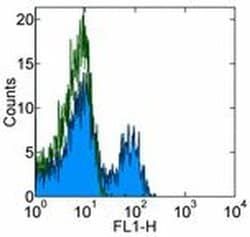
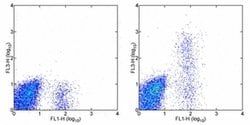
- Applications Tested: This eBioC1.7 antibody has been pre-diluted and tested by flow cytometric analysis of normal human peripheral blood cells
- This may be used at 5 μL (0.25 μg) per test
- A test is defined as the amount (μg) of antibody that will stain a cell sample in a final volume of 100 μL
- Cell number should be determined empirically but can range from 10^5 to 10^8 cells/test
- CD244 (2B4, SLAMF4) is a cell surface receptor expressed on natural killer (NK) cells (and some T cells) that mediate non-major histocompatibility complex (MHC) restricted killing
- The interaction between NK-cell and target cells via CD244 is thought to modulate NK-cell cytolytic activity
- CD244 interacts with SLAMF2, causing the activation of both SLAMF4- and SLAMF2-expressing cells
- Patients with systemic lupus erythmatosus have lower than normal levels of SLAMF4 expressed on their NK cells and monocytes, suggesting that SLAMF4 may play a role in the pathology of this autoimmune disease
- Diseases associated with CD244 dysfunction include rheumatoid arthritis and lymphoproliferative syndrome
- Alternatively spliced transcript variants encoding different isoforms of CD244 have been found for this gene.