36-501-9942
CD19 Monoclonal Antibody (HIB19), Brilliant Ultra Violet™ 563, eBioscience™, Invitrogen™
Manufacturer: Invitrogen
Select a Size
| Pack Size | SKU | Availability | Price |
|---|---|---|---|
| Each of 1 | 36-501-9942-Each-of-1 | In Stock | ₹ 35,867.00 |
36-501-9942 - Each of 1
In Stock
Quantity
1
Base Price: ₹ 35,867.00
GST (18%): ₹ 6,456.06
Total Price: ₹ 42,323.06
Antigen
CD19
Classification
Monoclonal
Concentration
5 μL/Test
Formulation
PBS with BSA and 0.09% sodium azide; pH 7.2
Gene Accession No.
P15391
Gene Symbols
Cd19
Purification Method
Affinity chromatography
Regulatory Status
RUO
Gene ID (Entrez)
930
Content And Storage
4° C, store in dark, DO NOT FREEZE!
Form
Liquid
Applications
Flow Cytometry
Clone
HIB19
Conjugate
Brilliant Ultraviolet 563
Gene
Cd19
Gene Alias
AW495831; B4; B-lymphocyte antigen CD19; B-lymphocyte surface antigen B4; Cd19; CD19 antigen; CD19 molecule; CVID3; differentiation antigen CD19; Leu-12; T-cell surface antigen Leu-12
Host Species
Mouse
Quantity
100 Tests
Primary or Secondary
Primary
Target Species
Human
Product Type
Antibody
Isotype
IgG1 κ
Related Products



Description
- The HIB19 mAb reacts with human CD19, a 95 kDa transmembrane glycoprotein
- CD19 is expressed by B cells during all stages of development excluding the terminally differentiated plasma cells
- Follicular dendritic cells also express CD19
- Together CD21, CD81, Leu13, MHC class II, and CD19 form a multimolecular complex that associates with BCR
- Signaling through CD19 induces tyrosine phosphorylation, calcium flux and proliferation of B cells
- The SJ25C1 antibody and the HIB19 mAb recognize overlapping epitopes
- Applications Reported: This HIB19 antibody has been reported for use in flow cytometric analysis
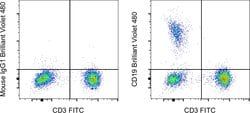
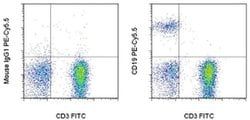
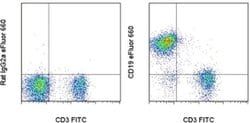
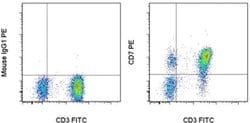
- Applications Tested: This HIB19 antibody has been pre-diluted and tested by flow cytometric analysis of normal human peripheral blood cells
- This may be used at 5μL (0.5μg) per test BUV563 is a tandem dye that emits at 564 nm and is intended for use on cytometers equipped with an Ultraviolet (355 nm) laser
- Please make sure that your instrument is capable of detecting this fluorochrome
- When using two or more Super Bright, BV, BUV, or other polymer dye-conjugated antibodies in a staining panel, it is recommended to use Super Bright Complete Staining Buffer (SB-4401-42) or Brilliant Stain Buffer (00-4409-75) to minimize any non-specific polymer interactions
- Light sensitivity: This tandem dye is sensitive to photo-induced oxidation
- Please protect this vial and stained samples from light
- Excitation: 350 nm; Emission: 564 nm; Laser: Ultraviolet Laser
- CD19 is a member of the immunoglobulin superfamily and has two Ig like domains
- The CD19 molecule is expressed on 100% of the peripheral B cells as defined by expression of kappa or lambda light chains
- CD19 appears to be expressed on myeloid leukemia cells, particularly those of monocytic lineage
- Leukemia phenotype studies have demonstrated that the earliest and broadest B cell restricted antigen is the CD19 antigen
- The receptor for CD19 is an important functional regulator of normal and malignant B cell proliferation, and is expressed in all B cell precursor leukemias
- Lymphocytes proliferate and differentiate in response to various concentrations of different antigens
- The ability of the B cell to respond in a specific, yet sensitive manner to the various antigens is achieved with the use of low-affinity antigen receptors
- CD19 is a cell surface molecule which assembles with the antigen receptor of B lymphocytes in order to decrease the threshold for antigen receptor-dependent stimulation
- Besides being a signal-amplifying coreceptor for the B cell receptor (BCR), CD19 can also signal independently of BCR co-ligation and is a central regulatory component upon which multiple signaling pathways converge
- Mutation of the CD19 gene results in hypogammaglobulinemia, whereas CD19 overexpression causes B cell hyperactivity.