CD11b Monoclonal Antibody (ICRF44), Brilliant Ultra Violet™ 805, eBioscience™, Invitrogen™
Manufacturer: Fischer Scientific
Select a Size
| Pack Size | SKU | Availability | Price |
|---|---|---|---|
| Each of 1 | 36-801-1842-Each-of-1 | In Stock | ₹ 36,579.00 |
36-801-1842 - Each of 1
In Stock
Quantity
1
Base Price: ₹ 36,579.00
GST (18%): ₹ 6,584.22
Total Price: ₹ 43,163.22
Antigen
CD11b
Classification
Monoclonal
Concentration
5 μL/Test
Formulation
PBS with BSA and 0.09% sodium azide; pH 7.2
Gene Accession No.
P11215
Gene Symbols
ITGAM
Purification Method
Affinity chromatography
Regulatory Status
RUO
Gene ID (Entrez)
101866035, 3684, 454069, 714832
Content And Storage
4° C, store in dark, DO NOT FREEZE!
Form
Liquid
Applications
Flow Cytometry
Clone
ICRF44
Conjugate
Brilliant Ultraviolet 805
Gene
ITGAM
Gene Alias
antigen CD11b (p170); antigen CD11b (p170); macrophage antigen alpha polypeptide; CD11 antigen-like family member B; CD11b; CD11B (p170); CD11b/CD18; cell surface glycoprotein MAC-1 alpha subunit; cell surface glycoprotein MAC-1 subunit alpha; complement component 3 receptor 3 subunit; complement component receptor 3 alpha-a; complement receptor type 3; CR3; CR-3 alpha chain; CR3A; F730045J24Rik; integrin alpha M; integrin alpha-M; integrin subunit alpha M; integrin, alpha M; integrin, alpha M (complement component 3 receptor 3 subunit); ITGAM; Leukocyte adhesion receptor MO1; leukocyte integrin alpha-M chain; LOC100351865; Ly-40; MAC1; Mac-1; Mac-1 alpha; Mac-1 alpha (Mac1A); MAC-1 alpha subunit; MAC1A; Mac-1a; macrophage antigen alpha; macrophage antigen alpha polypeptide; MGC117044; MO1A; Neutrophil adherence receptor; neutrophil adherence receptor alpha-M subunit; SLEB6; unnamed protein product
Host Species
Mouse
Quantity
100 Tests
Primary or Secondary
Primary
Target Species
Baboon, Chimpanzee, Cynomolgus Monkey, Human, Rhesus Monkey
Product Type
Antibody
Isotype
IgG1 κ
Related Products
Description
- The ICRF44 monoclonal antibody reacts with human CD11b, a 165 kDa adhesion molecule
- CD11b associated with integrin beta2 (CD18) is expressed on the surface of monocytes, granulocytes, activated lymphocytes and a subset of NK cells
- CD11b is a receptor for intercellular adhesion molecule family members CD54, CD102 and CD50 as well as for iC3b
- These adhesions are crucial in cell-cell and cell-matrix interactions
- Applications Reported: This ICRF44 antibody has been reported for use in flow cytometric analysis
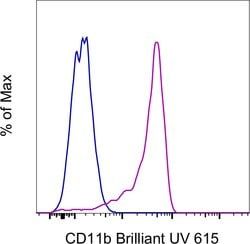
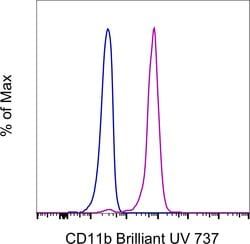
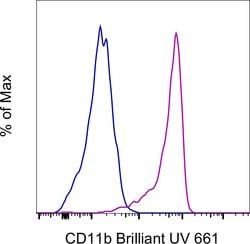
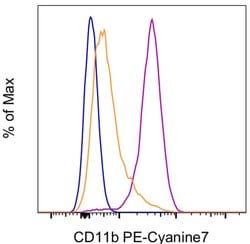
- Applications Tested: This ICRF44 antibody has been pre-diluted and tested by flow cytometric analysis of normal human peripheral blood cells
- This may be used at 5 μL (1.0 μg) per test
- A test is defined as the amount (μg) of antibody that will stain a cell sample in a final volume of 100 μL
- Cell number should be determined empirically but can range from 10^5 to 10^8 cells/test
- Brilliant Ultraviolet 805 is a tandem dye that emits at 797 nm and is intended for use on cytometers equipped with an ultraviolet (355 nm) laser
- CD11b (integrin alpha-M, ITGAM, integrin alpha-X, ITGAX) is a 165 kDa adhesion molecule that associates non-covalently with integrin beta-2 (CD18)
- The CD11b/CD18 heterodimeric complex is also known as integrin alpha-M beta-2, Mac-1, and CR3 (complement receptor 3)
- CD11b is expressed on the surface of monocytes/macrophages, granulocytes, activated lymphocytes, a subset of NK cells, a subset of dendritic cells, and microglia in the brain
- CD11b/CD18 functions as the receptor for ICAM-1 (CD54), ICAM-2 (CD102), ICAM-4 (CD242), CD14, CD50, CD23, heparin, iC3b, fibrinogen, and Factor X -these adhesions are critical for cell-cell and cell-matrix interactions
- CD11b is expressed on 8% of spleen cells, 44% of bone marrow cells, and less than 1% of thymocytes, and is commonly used as a microglial marker in nervous tissue
- The expression of CD11b increases during monocyte maturation and expression levels vary on tissue macrophages
- Further, peritoneal macrophages are reported to express higher levels of CD11b than splenic macrophages
- Diseases associated with CD11b dysfunction include systemic lupus erythematosus 6 and ITGAM-related susceptibility to systemic lupus erythematosus.