CDKN2C Monoclonal Antibody (ZP001), Invitrogen™
Manufacturer: Invitrogen
Select a Size
| Pack Size | SKU | Availability | Price |
|---|---|---|---|
| Each of 1 | 39-340-0-Each-of-1 | In Stock | ₹ 40,050.00 |
39-340-0 - Each of 1
In Stock
Quantity
1
Base Price: ₹ 40,050.00
GST (18%): ₹ 7,209.00
Total Price: ₹ 47,259.00
Antigen
CDKN2C
Classification
Monoclonal
Concentration
0.5 mg/mL
Formulation
PBS with 0.1% sodium azide; pH 7.4
Gene Accession No.
P42773, Q60772
Gene Symbols
CDKN2C
Immunogen
Recombinant, full-length mouse p18INK4c
Quantity
100 μg
Primary or Secondary
Primary
Target Species
Human, Mouse
Product Type
Antibody
Isotype
IgG1 κ
Applications
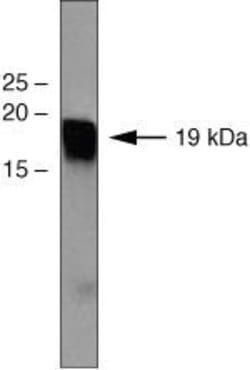
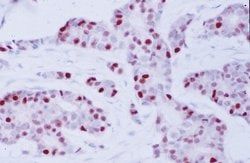
ELISA, Immunocytochemistry, Western Blot
Clone
ZP001
Conjugate
Unconjugated
Gene
CDKN2C
Gene Alias
C77269; CDK6 inhibitor p18; Cdkn2c; CDKN6; cyclin dependent kinase inhibitor 2C; cyclin-dependent inhibitor; cyclin-dependent kinase 4 inhibitor C; Cyclin-dependent kinase 6 inhibitor; cyclin-dependent kinase 6 inhibitor p18; cyclin-dependent kinase inhibitor 2C (p18, inhibits CDK4); INK4c; p18; p18INK4c; p18-INK4c; p18-INK6
Host Species
Mouse
Purification Method
Protein A
Regulatory Status
RUO
Gene ID (Entrez)
1031, 12580
Content And Storage
-20°C
Form
Liquid
Related Products


Description
- The protein encoded by this gene is a member of the INK4 family of cyclin-dependent kinase inhibitors
- This protein has been shown to interact with CDK4 or CDK6, and prevent the activation of the CDK kinases, thus function as a cell growth regulator that controls cell cycle G1 progression
- Ectopic expression of this gene was shown to suppress the growth of human cells in a manner that appears to correlate with the presence of a wild-type RB1 function
- Studies in the knockout mice suggested the roles of this gene in regulating spermatogenesis, as well as in suppressing tumorigenesis
- Two alternatively spliced transcript variants of this gene, which encode an identical protein, have been reported.