CD4 Monoclonal Antibody (RM4-5), Brilliant Violet™ 421, eBioscience™, Invitrogen™
Manufacturer: Fischer Scientific
Select a Size
| Pack Size | SKU | Availability | Price |
|---|---|---|---|
| Each of 1 | 40-400-4282-Each-of-1 | In Stock | ₹ 32,040.00 |
40-400-4282 - Each of 1
In Stock
Quantity
1
Base Price: ₹ 32,040.00
GST (18%): ₹ 5,767.20
Total Price: ₹ 37,807.20
Antigen
CD4
Classification
Monoclonal
Concentration
0.2 mg/mL
Formulation
PBS with BSA and 0.09% sodium azide; pH 7.2
Gene Accession No.
P06332
Gene Symbols
CD4
Purification Method
Affinity chromatography
Regulatory Status
RUO
Gene ID (Entrez)
12504
Content And Storage
4° C, store in dark, DO NOT FREEZE!
Form
Liquid
Applications
Flow Cytometry
Clone
RM4-5
Conjugate
Brilliant Violet 421
Gene
CD4
Gene Alias
Activation B7-1 antigen; B7; B7.1; B7-1; BB1; B-lymphocyte activation antigen B7; CD28LG; CD28LG1; CD4; CD4 antigen; CD4 antigen (p55); CD4 antigen p55; Cd4 molecule; CD4 precursor; CD4 receptor; CD4, allele 1; cd4a; CD4mut; CD80; CD80 antigen (CD28 antigen ligand 1, B7-1 antigen); CD80 molecule; cell surface glycoprotein CD4; costimulatory factor CD80; costimulatory molecule variant IgV-CD80; CTLA-4 counter-receptor B7.1; fCD4; L3T4; LAB7; Leu-3; Ly-4; lymphocyte antigen CD4; lymphocyte antigen CD4 precursor; membrane protein; p55; T-cell differentiation antigen L3T4; T-cell surface antigen T4/Leu-3; T-cell surface glycoprotein CD4; T-cell surface glycoprotein CD4 precursor (T-cell surface antigen T4/Leu-3) (T-cell differentiation antigen L3T4); T-lymphocyte activation antigen CD80; W3/25; W3/25 antigen
Host Species
Rat
Quantity
100 μg
Primary or Secondary
Primary
Target Species
Mouse
Product Type
Antibody
Isotype
IgG2a κ
Related Products


Description
- The RM4-5 monoclonal antibody reacts with the mouse CD4 molecule, a 55 kDa cell surface receptor expressed by a majority of thymocytes, subpopulation of mature T cells and dendritic cells
- CD4 binds to MHC class II on the surface of antigen presenting cells and plays an important role both in T cell development and in optimal functioning of mature T cells
- In T cells, CD4 associates with protein tyrosine kinase p56lck through its cytoplasmic tail
- Binding of RM4-5 is blocked by GK1.5
- Applications Reported: This RM4-5 antibody has been reported for use in flow cytometric analysis
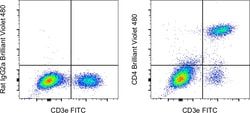
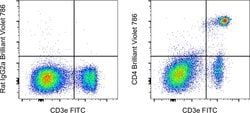
- Applications Tested: This RM4-5 antibody has been tested by flow cytometric analysis of mouse splenocytes
- This may be used at less than or equal to 0.125 μg per test Brilliant Violet 421 (BV421) is a dye that emits at 423 nm and is intended for use on cytometers equipped with a violet (405 nm) laser
- Please make sure that your instrument is capable of detecting this fluorochrome
- When using two or more Super Bright, Brilliant Violet, Brilliant Ultra Violet, or other polymer dye-conjugated antibodies in a staining panel, it is recommended to use Super Bright Complete Staining Buffer (SB-4401-42) or Brilliant Stain Buffer (00-4409-75) to minimize any non-specific polymer interactions
- Excitation: 407 nm; Emission: 423 nm; Laser: Violet Laser
- BRILLIANT Violet is a trademark or registered trademark of Becton, Dickinson and Company or its affiliates, and is used under license
- Powered by Sirigen
- The CD4 antigen is involved in the recognition of MHC class II molecules and is a co-receptor for HIV
- CD4 is primarily expressed in a subset of T-lymphocytes, also referred to as T helper cells, but may also be expressed by other cells in the immune system, such as monocytes, macrophages, and dendritic cells
- At the tissue level, CD4 expression may be detected in thymus, lymph nodes, tonsils, and spleen, and also in specific regions of the brain, gut, and other non-lymphoid tissues
- CD4 functions to initiate or augment the early phase of T-cell activation through its association with the T-cell receptor complex and protein tyrosine kinase, Lck
- It may also function as an important mediator of direct neuronal damage in infectious and immune-mediated diseases of the central nervous system
- Multiple alternatively spliced transcripts have been identified in this gene [RefSeq, July 2017].