CD284 (TLR4) Monoclonal Antibody (HTA125), APC-eFluor™ 780, eBioscience™, Invitrogen™
Manufacturer: Fischer Scientific
Select a Size
| Pack Size | SKU | Availability | Price |
|---|---|---|---|
| Each of 1 | 47-991-742-Each-of-1 | In Stock | ₹ 37,647.00 |
47-991-742 - Each of 1
In Stock
Quantity
1
Base Price: ₹ 37,647.00
GST (18%): ₹ 6,776.46
Total Price: ₹ 44,423.46
Antigen
CD284 (TLR4)
Classification
Monoclonal
Concentration
5 μL/Test
Formulation
PBS with 0.2% BSA and 0.09% sodium azide; pH 7.2
Gene Accession No.
O00206
Gene Symbols
TLR4
Purification Method
Affinity chromatography
Regulatory Status
RUO
Gene ID (Entrez)
7099
Content And Storage
4° C, store in dark, DO NOT FREEZE!
Form
Liquid
Applications
Flow Cytometry
Clone
HTA125
Conjugate
APC-eFluor 780
Gene
TLR4
Gene Alias
ARMD10; CD284; EGK_07381; homolog of Drosophila toll; hToll; lipopolysaccharide response; Lps; Ly87; Ran/M1; Rasl2-8; Tlr4; TLR-4; TOLL; toll like receptor 4; toll/interleukin-l receptor (TIR) domain; toll4; toll-like receptor 4; toll-like receptor 4 immunity-related protein; Toll-like receptor 4-like protein; Toll-like receptor4 protein
Host Species
Mouse
Quantity
100 Tests
Primary or Secondary
Primary
Target Species
Human
Product Type
Antibody
Isotype
IgG2a κ
Related Products

Description
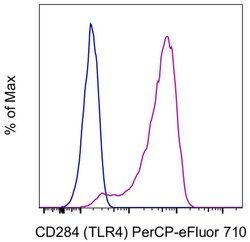
- TLR4 is member of the Toll like receptor (TLR) family which plays a fundamental role in pathogen recognition and activation of innate immunity
- TLRs are highly conserved from Drosophila to humans and share structural and functional similarities
- This receptor is most abundantly expressed in placenta, and in myelomonocytic subpopulation of the leukocytes
- Mammalian cells respond to LPS by activating TLR4
- TLR4 belongs to the multi-protein complex of lipopolysaccharide (LPS) receptor, containing CD14, LY96 and TLR4, and is involved in signal transduction events induced by lipopolysaccharide (LPS) found in most gram-negative bacteria
- TLR4 aids in the recognition of pathogen-associated molecular patterns (PAMPs) that are expressed on infectious agents, and mediate the production of cytokines necessary for the development of effective immunity
- The various TLRs exhibit different patterns of expression
- Mutations in the TLR4 gene have been associated with differences in LPS responsiveness
- Also, several transcript variants of the TLR4 gene have been found, but the protein coding potential of most of them is uncertain
- TLR4 is expressed by peripheral blood monocytes and a small population of B-cells and is also expressed in human placenta
- Studies with TLR4-deficient mice indicate that the main ligand for TLR is lipopolysaccharide
- Consequently, these mice also showed increased susceptibility to Gram-negative sepsis.