50-103-40
CD38 Monoclonal Antibody (HB7), PE, eBioscience™, Invitrogen™
Manufacturer: Invitrogen
Select a Size
| Pack Size | SKU | Availability | Price |
|---|---|---|---|
| Each of 1 | 50-103-40-Each-of-1 | In Stock | ₹ 23,229.00 |
50-103-40 - Each of 1
In Stock
Quantity
1
Base Price: ₹ 23,229.00
GST (18%): ₹ 4,181.22
Total Price: ₹ 27,410.22
Antigen
CD38
Classification
Monoclonal
Concentration
5 μL/Test
Formulation
PBS with 0.1% gelatin, 0.2% BSA and 0.09% sodium azide; pH 7.2
Gene Accession No.
P28907
Gene Symbols
CD38
Purification Method
Affinity chromatography
Regulatory Status
RUO
Gene ID (Entrez)
952
Content And Storage
4° C, store in dark, DO NOT FREEZE!
Form
Liquid
Applications
Flow Cytometry
Clone
HB7
Conjugate
PE
Gene
CD38
Gene Alias
T10, ADP-ribosyl cyclase 1, ADP-ribosyl cyclase/cyclic ADP-ribose hydrolase, CD38 antigen p45, NAD+ nucleosidase, cADPr hydrolase 1, cyclic ADP-ribose hydrolase 2
Host Species
Mouse
Quantity
100 Tests
Primary or Secondary
Primary
Target Species
Human
Product Type
Antibody
Isotype
IgG1 κ
Related Products
Description
- Description: The HB7 monoclonal antibody reacts with the human CD38 molecule, an approximately 45 kDa type II transmembrane protein
- CD38 is an ectoenzyme which catalyses NAD into nicotinic acid adenine dinucleotide phosphate (NAADP) and cyclic ADP-ribose (cADPR), both of which are secondary messengers
- Expression of CD38 is bimodal during B cell development, modulating from high in immature cells to low in intermediate ones and back to high on mature B cells
- Additionally CD38 is found in a variety of tissues and other hematopoietic cells (e.g
- T cells, NK cells and monocytes) and can be used to phenotype leukemias and monitor HIV-1 progression
- The CD34+CD38- population of hematopoietic stems cells is thought to define the most pluripotent cells (e.g
- blast colony forming cells)
- In addition to surface expression, CD38 has recently been found in the nucleus where it may play a role in monitoring calcium levels
- Applications Reported: This HB7 antibody has been reported for use in flow cytometric analysis
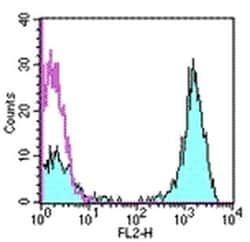
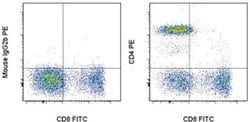
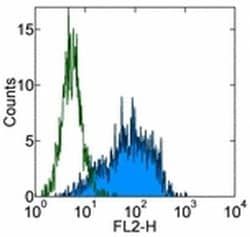
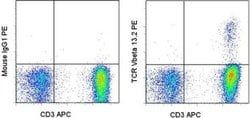
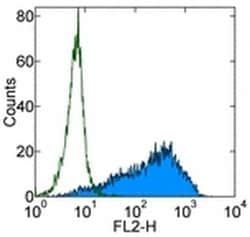
- Applications Tested: This HB7 antibody has been pre-titrated and tested by flow cytometric analysis of normal human peripheral blood cells
- This can be used at 5 µL (0.06 µg) per test
- A test is defined as the amount (µg) of antibody that will stain a cell sample in a final volume of 100 µL
- Cell number should be determined empirically but can range from 10^5 to 10^8 cells/test
- Excitation: 488-561 nm; Emission: 578 nm; Laser: Blue Laser, Green Laser, Yellow-Green Laser
- Filtration: 0.2 μm post-manufacturing filtered
- CD38 (NAD+ glycohydrolase) is a type II transmembrane glycoprotein able to induce activation, proliferation and differentiation of mature lymphocytes and mediate apoptosis of myeloid and lymphoid progenitor cells
- CD38 functions as a multi-catalytic ectoenzyme serving as ADP-ribosyl cyclase, cyclic ADP-ribose hydrolase and possibly NAD+ glycohydrolase or as a cell surface receptor
- Antibodies to CD38 are useful in subtyping of lymphomas and leukemias, detection of plasma cells (i.e
- identification of myelomas), and as a marker for activated B and T cells
- CD38 participates in cell adhesion, signal transduction and calcium signaling
- Further, CD38 is expressed at high levels in the pancreas, liver, kidney, maligt lymphoma and neuroblastoma
- Diseases associated with CD38 dysfunction include chronic lymphocytic leukemia and Richter’s Syndrome.