CD61 (Integrin beta 3) Monoclonal Antibody (2C9.G3), PE, eBioscience™, Invitrogen™
Manufacturer: Fischer Scientific
Select a Size
| Pack Size | SKU | Availability | Price |
|---|---|---|---|
| Each of 1 | 50-104-37-Each-of-1 | In Stock | ₹ 32,574.00 |
50-104-37 - Each of 1
In Stock
Quantity
1
Base Price: ₹ 32,574.00
GST (18%): ₹ 5,863.32
Total Price: ₹ 38,437.32
Antigen
CD61 (Integrin beta 3)
Classification
Monoclonal
Concentration
0.2 mg/mL
Formulation
PBS with 0.09% sodium azide; pH 7.2
Gene Accession No.
O54890
Gene Symbols
ITGB3
Purification Method
Affinity chromatography
Regulatory Status
RUO
Gene ID (Entrez)
16416, 29302
Content And Storage
4° C, store in dark, DO NOT FREEZE!
Form
Liquid
Applications
Flow Cytometry
Clone
2C9.G3
Conjugate
PE
Gene
ITGB3
Gene Alias
antigen CD61; BDPLT16; BDPLT2; beta3 integrin; CD61; EGK_08849; glycoprotein GPIIIa; glycoprotein IIIa; GP3A; GPIIIa; GT; INGRB3; integrin beta 3; integrin beta 3 (Cd61); integrin beta-3; integrin beta-3 subunit; integrin subunit beta 3; integrin, beta 3; integrin, beta 3 (platelet glycoprotein IIIa, antigen CD61); ITGB3; platelet glycoprotein IIIa; platelet glycoprotein IIIa integrin subunit beta 3; platelet gpIIIa; platelet membrane glycoprotein IIIa
Host Species
Armenian Hamster
Quantity
200 μg
Primary or Secondary
Primary
Target Species
Mouse, Rat
Product Type
Antibody
Isotype
IgG
Related Products

Description
- Description: The 2C9.G3 (HMb3-1) monoclonal antibody reacts with mouse and rat CD61, also known as the integrin beta3
- CD61 is expressed by activated T cells, granulocytes, and platelet
- CD61 associates non-covalently with two integrin alpha subunits; alphaV (CD51) to form Vitronectin Receptor and alphaIib (CD41) to form gpIIb/IIIa
- These heterodimeric complexes are responsible for adhesion to extracellular matrix components including fibrinogen, fibronectin, fibronectin, vitronectin, thrombospondin and von Willebrand factor
- Applications Reported: The 2C9.G3 antibody has been reported for use in flow cytometric analysis
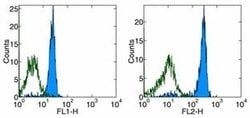
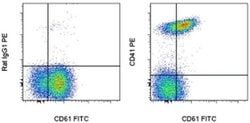
- Applications Tested: The 2C9.G3 antibody has been tested by flow cytometric analysis of mouse splenocytes and bone marrow cells
- This can be used at less than or equal to 0.5 μg per test
- A test is defined as the amount (μg) of antibody that will stain a cell sample in a final volume of 100 μL
- Cell number should be determined empirically but can range from 10^5 to 10^8 cells/test
- It is recommended that the antibody be carefully titrated for optimal performance in the assay of interest
- Excitation: 488-561 nm; Emission: 578 nm; Laser: Blue Laser, Green Laser, Yellow-Green Laser
- Filtration: 0.2 μm post-manufacturing filtered
- CD61 (GPIIIa, ITGB3) is a glycoprotein found on megakaryocytes, platelets and their precursors
- CD61 antigen plays a role in platelet aggregation and also as a receptor for fibrinogen, fibronectin, von Willebrand factor and vitronectrin
- CD61 is a 105 kDa glycoprotein that associates with either the alpha 11b integrin (CD41) or the alpha V integrin (CD51) at the cell surface
- CD61 is expressed on platelets and megakaryocytes in association with CD41, and on endothelial cells, monocytes, platelets and osteoclasts in association with CD51
- CD61 is a receptor for fibrinogen, fibronectin, Von Willebrand Factor, vitronectin and thrombospondin
- The CD61 protein product is composed of an alpha chain and a beta chain
- A given chain may combine with multiple partners resulting in different integrins
- CD61 is found along with the alpha IIb chain in platelets
- Like other integrins, CD61 is known to participate in cell adhesion as well as cell-surface mediated signaling
- Diseases associated with CD61 dysfunction include Glanzmann Thrombasthenia and Platelet type-16 Bleeding Disorder.