CD85g (ILT7) Monoclonal Antibody (eBio17G10.2 (17G10.2)), PE, eBioscience™, Invitrogen™
Manufacturer: Invitrogen
Select a Size
| Pack Size | SKU | Availability | Price |
|---|---|---|---|
| Each of 1 | 50-108-10-Each-of-1 | In Stock | ₹ 32,663.00 |
50-108-10 - Each of 1
In Stock
Quantity
1
Base Price: ₹ 32,663.00
GST (18%): ₹ 5,879.34
Total Price: ₹ 38,542.34
Antigen
CD85g (ILT7)
Classification
Monoclonal
Concentration
5 μL/Test
Formulation
PBS with 0.2% BSA and 0.09% sodium azide; pH 7.2
Gene Accession No.
P59901
Gene Symbols
LILRA4
Purification Method
Affinity chromatography
Regulatory Status
RUO
Gene ID (Entrez)
23547
Content And Storage
4° C, store in dark, DO NOT FREEZE!
Form
Liquid
Applications
Flow Cytometry
Clone
eBio17G10.2 (17G10.2)
Conjugate
PE
Gene
LILRA4
Gene Alias
CD85 antigen-like family member G; CD85g; ILT7; ILT-7; Immunoglobulin-like transcript 7; leucocyte Ig-like receptor A4; leukocyte immunoglobulin like receptor A4; leukocyte immunoglobulin-like receptor subfamily A member 4; leukocyte immunoglobulin-like receptor, subfamily A (with TM domain), member 4; leukocyte immunoglobulin-like receptor, subfamily A (without TM domain), member 4; LILRA4
Host Species
Mouse
Quantity
100 Tests
Primary or Secondary
Primary
Target Species
Human
Product Type
Antibody
Isotype
IgG1
Related Products

Description
- Description: The eBio17G10.2 monoclonal antibody reacts with human immunoglobulin-like transcript 7 (ILT7), also known as CD85g
- ILT7 is part of the leukocyte immunoglobulin-like receptor (LIR) gene family and associates with Fc epsilon R1 gamma to form a functional complex which transduces ITAM-mediated signals that negatively modulates TLR-induced type I IFN production by human plasmacytoid dendritic cells
- ILT7 is expressed exclusively on plasmacytoid dendritic cells and is absent in monocyte derived DCs
- Treatment with IL-3 or CpG causes a decrease in expression
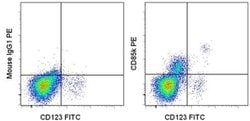
- Double staining of human PBMCs with eBio17G10.2 and anti-pDC marker BDCA2 yields virtually complete co-staining
- Cross linking of ILT7 with eBio17G10.2 antibody causes reduced transcription of IFN alpha1, IFN alpha2, IFN alpha4 and IFN beta
- Applications Reported: This eBio17G10.2 (17G10.2) antibody has been reported for use in flow cytometric analysis
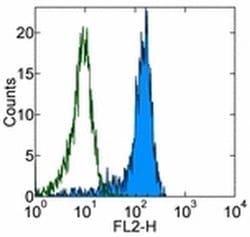
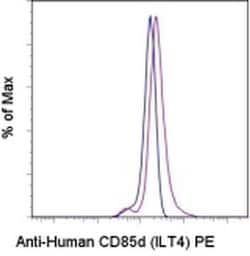
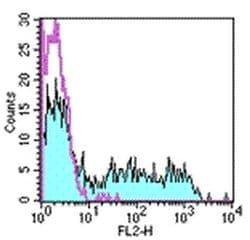
- Applications Tested: This eBio17G10.2 (17G10.2) antibody has been pre-titrated and tested by flow cytometric analysis of normal human peripheral blood cells
- This can be used at 5 μL (0.125 μg) per test
- A test is defined as the amount (μg) of antibody that will stain a cell sample in a final volume of 100 μL
- Cell number should be determined empirically but can range from 10^5 to 10^8 cells/test
- Excitation: 488-561 nm; Emission: 578 nm; Laser: Blue Laser, Green Laser, Yellow-Green Laser
- Filtration: 0.2 μm post-manufacturing filtered
- ILT7 is a pDC-specific IgG-like transcript and is a member of the leukocyte immunoglobulin-like receptor gene family
- This receptor, in complex with FcER1a, transduces ITAM-mediated signals which negatively modulate type I IFN production by pDC
- ILT7 is thus a potential target to regulate Type 1 IFN production by pDC, which play a major role during viral infection, auto-immune diseases and anti-cancer immunity
- Additionally, ILT7, along with CD123 and BDCA-2, can be used to identify or classify subsets of pDCalong with TLR expression and TLR mediated immune responses.