CD338 (ABCG2) Monoclonal Antibody (5D3), PE, eBioscience™, Invitrogen™
Manufacturer: Invitrogen
Select a Size
| Pack Size | SKU | Availability | Price |
|---|---|---|---|
| Each of 1 | 50-112-2400-Each-of-1 | In Stock | ₹ 30,438.00 |
50-112-2400 - Each of 1
In Stock
Quantity
1
Base Price: ₹ 30,438.00
GST (18%): ₹ 5,478.84
Total Price: ₹ 35,916.84
Antigen
CD338 (ABCG2)
Classification
Monoclonal
Concentration
5 μL/Test
Formulation
PBS with 0.2% BSA and 0.09% sodium azide; pH 7.2
Gene Accession No.
Q9UNQ0
Gene Symbols
ABCG2
Purification Method
Affinity chromatography
Regulatory Status
RUO
Gene ID (Entrez)
9429
Content And Storage
4° C, store in dark, DO NOT FREEZE!
Form
Liquid
Applications
Flow Cytometry
Clone
5D3
Conjugate
PE
Gene
ABCG2
Gene Alias
ABC transporter; ABC15; Abcg2; ABCP; AI428558; ATP binding cassette subfamily G member 2 (Junior blood group); ATP-binding cassette sub-family G member 2; ATP-binding cassette transporter G2; ATP-binding cassette, sub-family G (WHITE), member 2; ATP-binding cassette, sub-family G (WHITE), member 2 (Junior blood group); BCRP; Bcrp1; BMDP; Breast cancer resistance protein; breast cancer resistance protein 1 homolog; Broad substrate specificity ATP-binding cassette transporter ABCG2; CD338; CDw338; EST157481; GOUT1; mitoxantrone resistance protein 1; mitoxantrone resistance-associated protein; MRX; multi drug resistance efflux transport ATP-binding cassette sub-family G (WHITE) member 2; MXR; MXR1; MXR-1; placenta specific MDR protein; placenta-specific ATP-binding cassette transporter; UAQTL1; Urate exporter
Host Species
Mouse
Quantity
100 Tests
Primary or Secondary
Primary
Target Species
Human
Product Type
Antibody
Isotype
IgG2b κ
Related Products

Description
- Description: The 5D3 monoclonal antibody reacts with the extracellular portion of the human ABCG2 protein, also known as Bcrp1 and MXR
- The ABCG2 gene, a member of the multi-drug resistance (MDR) family, is highly expressed on primitive 'side-population' (SP) stem cells, which are defined by the efflux of fluorescent dyes such as Rhodamine 123 and Hoechest 33342
- In the bone marrow, about 0.05% of cells display the low fluorescence and are highly enriched for repopulating cells
- The SP cells, which express low or undetectable levels of CD34, have been identified in multiple species
- In addition, expression of ABCG2 appears to be highly conserved
- Applications Reported: The 5D3 antibody has been reported for use in flow cytometric analysis
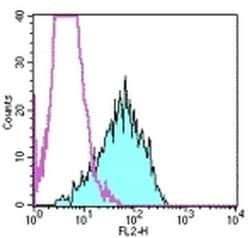
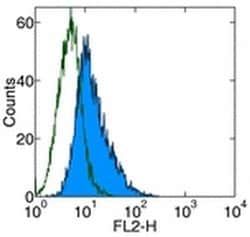
- Applications Tested: This 5D3 antibody is tested by flow cytometric analysis of ABCG2 transfected cells and peripheral blood cells
- It is offered in 2 formats: - μg size: has been tested by flow cytometric analysis of ABCG2 transfectant cells and peripheral blood
- This can be used at less than or equal to 0.5 μg per test
- A test is defined as the amount (μg) of antibody that will stain a cell sample in a final volume of 100 μL
- Cell number should be determined empirically but can range from 10^5 to 10^8 cells/test
- It is recommended that the antibody be carefully titrated for optimal performance in the assay of interest
- ABCG2, is also known as placenta-specific ABC transporter and breast cancer resistance protein (BCRP1)
- ABCG2 confers resistance for a variety of chemotherapeutic agents, including anthracyclines, mitoxantrone, bisantrene and topotecan
- Under normal conditions, ABCG2 may serve a protective function by removing toxins from the cell, and plays an important role in regulating stem cell differentiation
- ABCG2 is responsible for the side population (SP) phenotype and is widely expressed in a large variety of stem cells, making it an important stem cell marker
- ABCG2 may have N-linked glycosylation and may dimerize in vivo
- ABCG2 is abundantly expressed in placenta, liver, intestine and stem cells.