50-112-3064
CD81 Monoclonal Antibody (1D6-CD81), APC, eBioscience™, Invitrogen™
Manufacturer: Invitrogen
Select a Size
| Pack Size | SKU | Availability | Price |
|---|---|---|---|
| Each of 1 | 50-112-3064-Each-of-1 | In Stock | ₹ 29,637.00 |
50-112-3064 - Each of 1
In Stock
Quantity
1
Base Price: ₹ 29,637.00
GST (18%): ₹ 5,334.66
Total Price: ₹ 34,971.66
Antigen
CD81
Classification
Monoclonal
Concentration
5 μL/Test
Formulation
PBS with 0.2% BSA and 0.09% sodium azide; pH 7.2
Gene Accession No.
P60033
Gene Symbols
CD81
Purification Method
Affinity chromatography
Regulatory Status
RUO
Gene ID (Entrez)
975
Content And Storage
4° C, store in dark, DO NOT FREEZE!
Form
Liquid
Applications
Flow Cytometry
Clone
1D6-CD81
Conjugate
APC
Gene
CD81
Gene Alias
26 kDa cell surface protein TAPA-1; CD 81 antigen; Cd81; CD81 antigen; CD81 antigen (target of antiproliferative antibody 1); CD81 molecule; CVID6; S5.7; Tapa1; Tapa-1; Target of the antiproliferative antibody 1; Tetraspanin28; tetraspanin-28; Tspan28; Tspan-28
Host Species
Mouse
Quantity
100 Tests
Primary or Secondary
Primary
Target Species
Human
Product Type
Antibody
Isotype
IgG1
Related Products



Description
- Description: This 1D6-CD81 monoclonal antibody reacts with human CD81, which is also known as Target of Anti-Proliferative Ab-1 (TAPA-1)
- A member of the tetraspanin superfamily of transmembrane proteins, CD81 is widely expressed on immune cells such as B, T, and NK cells, monocytes, and eosinophils
- Studies suggest that the highest expression of CD81 can be found on germinal center B cells
- This protein can also be detected on non-Hodgkin lymphomas and diffuse large B-cell lymphomas
- On B cells, CD81 exists in a complex with CD19, CD21, and Leu13
- CD81 plays a role in segregating the CD19/CD21-B cell receptor complexes to lipid rafts to activate signal transduction
- Finally, CD81 is a receptor for hepatitis C virus
- The 1D6 monoclonal antibody has been reported to induce adhesion and reduce cell proliferation
- Applications Reported: This 1D6-CD81 antibody has been reported for use in flow cytometric analysis
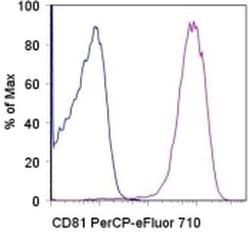
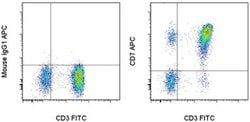
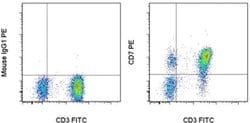
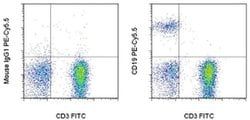
- Applications Tested: This 1D6-CD81 antibody has been pre-titrated and tested by flow cytometric analysis of normal human peripheral blood cells
- This can be used at 5 μL (1 μg) per test
- A test is defined as the amount (μg) of antibody that will stain a cell sample in a final volume of 100 μL
- Cell number should be determined empirically but can range from 10^5 to 10^8 cells/test
- Excitation: 633-647 nm; Emission: 660 nm; Laser: Red Laser
- Filtration: 0.2 μm post-manufacturing filtered
- CD81 (TAPA-1, target of anti-proliferative antibody-1) is a member of the tetraspanin family, is expressed on virtually all nucleated cells, but above all on germinal center B cells
- CD81 forms complexes with other tetraspanin proteins, integrins, coreceptors, MHC class I and II molecules, and influences adhesion, morphology, activation, proliferation and differentiation of B, T cells
- In muscles, CD81 promotes cell fusion and myotube maintenance
- CD81 has been also identified as a receptor for the hepatitis C virus
- Like members of the tetraspanin family that include CD9, CD37, CD53, CD63, and CD82, CD81 is a cell-surface proteins that are characterized by the presence of four hydrophobic domains
- The proteins mediate signal transduction events that play a role in the regulation of cell development, activation, growth and motility
- CD81 is a cell surface glycoprotein that is known to complex with integrins
- CD81 appears to promote muscle cell fusion and support myotube maintenance
- CD81 associates with CD19, CD21, Leu 13, and integrins on cell membrane and acts as a receptor for the envelope protein E2 of chronic hepatitis C virus
- Antibodies to CD81 have anti-proliferative effects on different lymphoid cell lines, particularly those derived from large cell lymphomas
- CD81 is also localized in the tumor-suppressor gene region and is a candidate gene for malignancies.