FceR1 alpha Monoclonal Antibody (MAR-1), APC, eBioscience™, Invitrogen™
Manufacturer: Fischer Scientific
Select a Size
| Pack Size | SKU | Availability | Price |
|---|---|---|---|
| Each of 1 | 50-112-8693-Each-of-1 | In Stock | ₹ 12,549.00 |
50-112-8693 - Each of 1
In Stock
Quantity
1
Base Price: ₹ 12,549.00
GST (18%): ₹ 2,258.82
Total Price: ₹ 14,807.82
Antigen
FceR1 alpha
Classification
Monoclonal
Concentration
0.2 mg/mL
Formulation
PBS with 0.09% sodium azide; pH 7.2
Gene Accession No.
P20489
Gene Symbols
FCER1A
Purification Method
Affinity chromatography
Regulatory Status
RUO
Gene ID (Entrez)
14125
Content And Storage
4° C, store in dark, DO NOT FREEZE!
Form
Liquid
Applications
Flow Cytometry
Clone
MAR-1
Conjugate
APC
Gene
FCER1A
Gene Alias
alpha polypeptide; fc epsilon r1; Fc epsilon receptor Ia; Fc epsilon RI alpha-chain; Fc fragment of IgE receptor Ia; Fc fragment of IgE, high affinity I, receptor for; alpha polypeptide; Fc IgE receptor, alpha polypeptide; Fc receptor, IgE, high affinity I, alpha polypeptide; Fce1a; Fc-epsilon RI-alpha; fcepsilonri; FCER1A; FcERI; Fcr-5; high affinity immunoglobulin epsilon receptor alpha-subunit; high affinity immunoglobulin epsilon receptor subunit alpha; IgE Fc receptor subunit alpha; Iger01; immunoglobulin E receptor, high-affinity, of mast cells, alpha polypeptide; RATIGER01; RP11-550P17.3
Host Species
Armenian Hamster
Quantity
25 μg
Primary or Secondary
Primary
Target Species
Mouse
Product Type
Antibody
Isotype
IgG
Related Products

Description
- Description: The MAR-1 monoclonal antibody reacts with the Fc epsilon Receptor I alpha subunit, an IgE-binding subunit lacking signal-transducing ability
- Fc epsilon RI alpha; is expressed on mast and basophil cells and is up-regulated by the presence of IgE
- Fc epsilon RI alpha forms a tetrameric complex with one beta and two gamma subunits
- The beta and gamma subunits possess immunoreceptor tyrosine-based activation motifs (ITAM)
- The Fc epsilon RI complex plays an important role in triggering IgE-mediated allergic reactions
- Applications Reported: This MAR-1 antibody has been reported for use in flow cytometric analysis
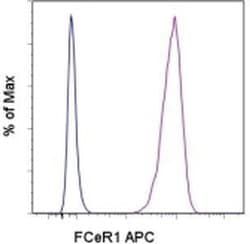
- Applications Tested: This MAR-1 antibody has been tested by flow cytometric analysis of the mast cell line MC/9
- This can be used at less than or equal to 0.125 μg per test
- A test is defined as the amount (μg) of antibody that will stain a cell sample in a final volume of 100 μL
- Cell number should be determined empirically but can range from 10^5 to 10^8 cells/test
- It is recommended that the antibody be carefully titrated for optimal performance in the assay of interest
- Excitation: 633-647 nm; Emission: 660 nm; Laser: Red Laser
- Filtration: 0.2 μm post-manufacturing filtered
- FceR1 (Fc epsilonR1 alpha) is a subunit of the high affinity receptor of IgE
- Fc epsilonR1 alpha is a tetrameric complex consisting of one alpha, one β and two additional subunits
- The latter two are required for signal transduction activity
- The Fc epsilonR1 complex plays an important role in triggering allergic responses, and the immunoglobulin epsilon receptor (IgE receptor) is the initiator of the allergic response
- When two or more high-affinity IgE receptors are brought together by allergen-bound IgE molecules, mediators such as histamine, which are responsible for allergy symptoms, are released
- The IgE receptor couples allergen and mast cells to initiate the inflammatory responses that are characteristic of disorders such as hay fever and asthma
- The release of histamine and proteases leads to the synthesis of prostaglandins and leukotrienes-potent effectors of the hypersensitivity response.