CD140a (PDGFRA) Monoclonal Antibody (APA5), Biotin, eBioscience™, Invitrogen™
Manufacturer: Fischer Scientific
Select a Size
| Pack Size | SKU | Availability | Price |
|---|---|---|---|
| Each of 1 | 50-112-8704-Each-of-1 | In Stock | ₹ 19,580.00 |
50-112-8704 - Each of 1
In Stock
Quantity
1
Base Price: ₹ 19,580.00
GST (18%): ₹ 3,524.40
Total Price: ₹ 23,104.40
Antigen
CD140a (PDGFRA)
Classification
Monoclonal
Concentration
0.5 mg/mL
Formulation
PBS with 0.09% sodium azide; pH 7.2
Gene Accession No.
P26618
Gene Symbols
PDGFRA
Purification Method
Affinity chromatography
Regulatory Status
RUO
Gene ID (Entrez)
18595
Content And Storage
4° C, store in dark, DO NOT FREEZE!
Form
Liquid
Applications
Flow Cytometry
Clone
APA5
Conjugate
Biotin
Gene
PDGFRA
Gene Alias
AI115593; alpha platelet-derived growth factor receptor; Alpha platelet-derived growth factor receptor precursor (PDGF-R-alpha); alpha-type platelet-derived growth factor receptor; APDGFR; CD140 antigen-like family member A; CD140A; CD140a antigen; GAS9; MGC74795; OTTHUMP00000218656; PDGF A-chain; PDGF alpha chain; PDGF Receptor alpha; PDGF subunit A; PDGF-1; PDGFACE; PDGFR2; Pdgfr-2; PDGFRA; pdgfr-a; PDGFRA/BCR fusion; PDGF-R-alpha; PDGFR-alpha; platelet derived growth factor receptor alpha; platelet derived growth factor receptor, alpha polypeptide; platelet-derived growth factor alpha receptor; Platelet-derived growth factor receptor 2; platelet-derived growth factor receptor alpha; platelet-derived growth factor receptor, alpha polypeptide; rearranged-in-hypereosinophilia-platelet derived growth factor receptor alpha fusion protein; RHEPDGFRA
Host Species
Rat
Quantity
100 μg
Primary or Secondary
Primary
Target Species
Mouse
Product Type
Antibody
Isotype
IgG2a κ
Related Products


Description
- Description: The APA5 monoclonal antibody reacts with the mouse CD140a molecule, the alpha chain of the platelet derived growth factor receptor (PDGF receptor)
- PDGFRa is a receptor tyrosine kinase that forms dimers on the surface upon ligand binding and phosphorylates substrates
- Dimers of PDGFR consist of either homodimers of alpha/alpha, beta/beta, or heterodimers of alpha/beta and serve as a substrate for its kinase activity
- CD140a is expressed by embryonic tissues and mesenchymal-derived cells of the adult mouse tissues
- Applications Reported: The APA5 antibody has been reported for use in flow cytometric analysis
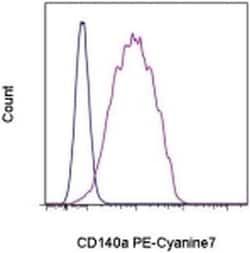
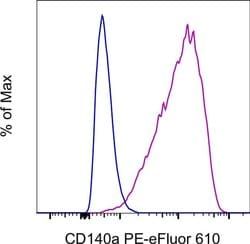
- Applications Tested: This APA5 antibody has been tested by flow cytometric analysis of NIH/3T3 cells
- This can be used at less than or equal to 1 μg per test
- A test is defined as the amount (μg) of antibody that will stain a cell sample in a final volume of 100 μL
- Cell number should be determined empirically but can range from 10^5 to 10^8 cells/test
- It is recommended that the antibody be carefully titrated for optimal performance in the assay of interest
- Filtration: 0.2 μm post-manufacturing filtered
- PDGFRA is a cell surface receptor tyrosine kinase which binds members of the platelet-derived growth factor family
- These growth factors are mitogens for cells of mesenchymal origin
- The identity of the growth factor bound to a receptor monomer determines whether the functional receptor is a homodimer or a heterodimer, composed of both platelet-derived growth factor receptor alpha and beta polypeptides
- Studies in knockout mice, where homozygosity is lethal, indicate that the alpha form of the platelet-derived growth factor receptor is particularly important for kidney development since mice heterozygous for the receptor exhibit defective kidney phenotypes.