50-112-8760
CD317 (BST2, PDCA-1) Monoclonal Antibody (eBio927), APC, eBioscience™, Invitrogen™
Manufacturer: Invitrogen
Select a Size
| Pack Size | SKU | Availability | Price |
|---|---|---|---|
| Each of 1 | 50-112-8760-Each-of-1 | In Stock | ₹ 33,731.00 |
50-112-8760 - Each of 1
In Stock
Quantity
1
Base Price: ₹ 33,731.00
GST (18%): ₹ 6,071.58
Total Price: ₹ 39,802.58
Antigen
CD317 (BST2, PDCA-1)
Classification
Monoclonal
Concentration
0.2 mg/mL
Formulation
PBS with 0.09% sodium azide; pH 7.2
Gene Accession No.
Q8R2Q8
Gene Symbols
Bst2
Purification Method
Affinity chromatography
Regulatory Status
RUO
Gene ID (Entrez)
69550
Content And Storage
4° C, store in dark, DO NOT FREEZE!
Form
Liquid
Applications
Flow Cytometry
Clone
eBio927
Conjugate
APC
Gene
Bst2
Gene Alias
2310015I10Rik; bone marrow stromal antigen 2; bone marrow stromal cell antigen 2; Bst2; BST-2; C87040; CD317; Damp1; DAMP-1; DAMP-1 protein homolog; GREG; HM1.24 antigen; NPC-A-7; PDCA-1; protein DAMP-1; TETHERIN
Host Species
Rat
Quantity
100 μg
Primary or Secondary
Primary
Target Species
Mouse
Product Type
Antibody
Isotype
IgG2b κ
Related Products


Description
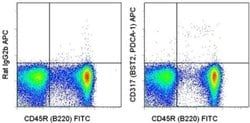
- Description: The eBio927 monoclonal antibody reacts with PDCA-1 (BST2, CD317), a specific marker of plasmacytoid dendritic cells (pDC), also known as type I IFN-producing cells (IPC) in the naive mouse
- Mouse IPCs are typically CD11c+, CD11b-, B220+, Ly-6C+, and CD62L+
- PDCA-1 is predomitly expressed by IPCs in the naive mouse which represents a very minor population (<0.5%) of splenocytes
- It is upregulated on numerous cell types following stimulation which triggers an IFN response
- PDCA-1 cycles between cell surface and intracellular compartments and may function to regulate trafficking of secreted cytokines
- PDCA-1 (BST2) is the protein recognized by antibody 120G8
- The eBio927 monoclonal antibody has also been shown to have functional activity
- The epitope recognized by eBio927 is distinct from eBio129c; thus, the antibodies can be used to costain, purify and identify pDCs
- Applications Reported: This eBio927 antibody has been reported for use in flow cytometric analysis
- Applications Tested: This eBio927 antibody has been tested by flow cytometric analysis of mouse splenocytes
- This can be used at less than or equal to 0.25 μg per test
- A test is defined as the amount (μg) of antibody that will stain a cell sample in a final volume of 100 μL
- Cell number should be determined empirically but can range from 10^5 to 10^8 cells/test
- BST2 (CD317, HM1.24 antigen, DAMP-2, tetherin) is an integral membrane protein that is involved in the development and growth of B-cells
- The surface expression of BST2 on fibroblast cell lines facilitated the stromal cell-dependent growth of DW34, a pre-B-cell line
- BST2 is highly expressed during B-cell development, from pro-B precursors to plasma cells, T-cells, monocytes, NK cells and DCs (at protein level), and myeloma cells
- Research studies have shown that BST2 also functions as an inhibitor of retrovirus release from human cells whose activity is antagonized by the HIV-1 accessory protein, Vpu
- While BST2 causes retention of virions on cell surfaces or endocytosis into BST2-positive compartments, its depletion abolished the viral requirement for Vpu for virus release, an activity that may represent a potential therapeutic strategy for the treatment of HIV/AIDS
- Another disease associated with BST2 dysfunction is stomatitis.