CD107a (LAMP-1) Monoclonal Antibody (eBioH4A3), eFluor™ 660, eBioscience™, Invitrogen™
Manufacturer: Invitrogen
Select a Size
| Pack Size | SKU | Availability | Price |
|---|---|---|---|
| Each of 1 | 50-112-9508-Each-of-1 | In Stock | ₹ 31,061.00 |
50-112-9508 - Each of 1
In Stock
Quantity
1
Base Price: ₹ 31,061.00
GST (18%): ₹ 5,590.98
Total Price: ₹ 36,651.98
Antigen
CD107a (LAMP-1)
Classification
Monoclonal
Concentration
5 μL/Test
Formulation
PBS with 0.2% BSA and 0.09% sodium azide; pH 7.2
Gene Accession No.
P11279
Gene Symbols
LAMP1
Purification Method
Affinity chromatography
Regulatory Status
RUO
Gene ID (Entrez)
3916
Content And Storage
4° C, store in dark, DO NOT FREEZE!
Form
Liquid
Applications
Flow Cytometry, Western Blot
Clone
eBioH4A3
Conjugate
eFluor 660
Gene
LAMP1
Gene Alias
120 kDa lysosomal membrane glycoprotein; AI196048; CD107 antigen-like family member A; CD107a; I79_011073; Lamp I; LAMP1; LAMP-1; LAMPA; LGP120; LGP-120; LGPA; LGP-A; lysosomal associated membrane protein 1; Lysosomal associated membrane protein 1 (120 kDa); lysosomal membrane glycoprotein 1; lysosomal membrane glycoprotein A; lysosomal-associated membrane protein 1; lysosome-associated membrane glycoprotein 1; LYSOSOME-ASSOCIATED MEMBRANE GLYCOPROTEIN 1 PRECURSOR (LAMP-1) (LGP-A) (LGP-120) (CD107A) (P2B); lysosome-associated membrane protein 1; P2B
Host Species
Mouse
Quantity
100 Tests
Primary or Secondary
Primary
Target Species
Human
Product Type
Antibody
Isotype
IgG1 κ
Related Products


Description
- Description: The eBioH4A3 monoclonal antibody reacts with human CD107a, also known as lysosomal-associated membrane protein-1 (LAMP-1)
- CD107a is a highly glycosylated protein of approximately 110kDa
- It is predominantly expressed intracellularly in the lysosomal/endosomal membrane in nearly all cells
- CD107a is transiently expressed on the cell surface of degranulating cytolytic T cells, and is also upregulated on the surface of activated platelets and some cancer cells
- Applications Reported: This H4A3 antibody has been reported for use in intracellular staining followed by flow cytometric analysis
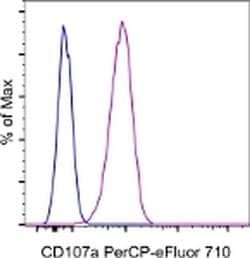
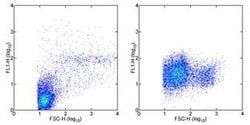
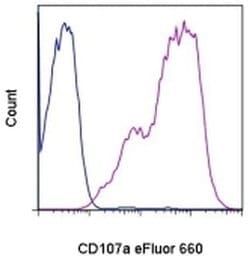
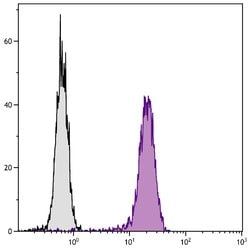
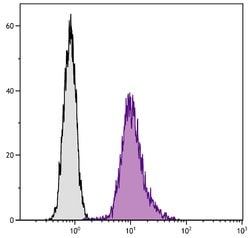
- Applications Tested: This eBioH4A3 antibody has been pre-titrated and tested by intracellular staining and flow cytometric analysis of the Jurkat cell line
- This can be used at 5 μL (0.125 μg) per test
- A test is defined as the amount (μg) of antibody that will stain a cell sample in a final volume of 100 μL
- Cell number should be determined empirically but can range from 10^5 to 10^8 cells/test
- eFluor™ 660 is a replacement for Alexa Fluor™ 647
- eFluor™ 660 emits at 659 nm and is excited with the red laser (633 nm)
- Please make sure that your instrument is capable of detecting this fluorochome
- Excitation: 633-647 nm; Emission: 668 nm; Laser: Red Laser
- Filtration: 0.2 μm post-manufacturing filtered
- LAMP1 (CD107a, lysosome-associated membrane protein-1) together with LAMP-2, is a major constituent of lysosomal membrane, 1-2% of total CD107a is found also on the plasma membrane
- LAMP1 is a heavily glycosylated membrane protein which contains a putative signal peptide, 18 sites for N-linked glycosylation, a single membrane-spanning segment and a short (11 amino acid) cytosolic tail
- The LAMP proteins are involved in lysosome biogenesis and are required for fusion of lysosomes with phagosomes
- LAMP1 is a type 1 integral membrane protein that is transported from trans-Golgi network to endosomes and then lysosomes
- Upon cell activation, LAMP1 transfer to the plasma membrane is dependent on a carboyxl-terminal tyrosine based motif (YXXI)
- Perturbation in the spacing between the tyrosine based motif relative to the membrane abolishes lysosome localization of LAMP1, and this mutant protein then cycles between the plasma membrane and the endosome
- Cell surface LAMP1 (and LAMP2) have been shown to promote adhesion of human peripheral blood mononuclear cells (PBMC) to vascular endothelium, therefore, they are possibly involved in the adhesion of PBMC to the site of inflammation
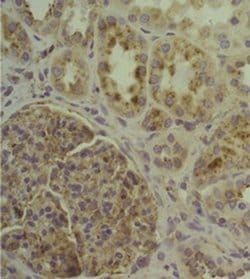
- Increased LAMP1 immunoreactivity is observed in neurons and glial cells surrounding senile plaques in Alzheimer’s Disease (AD) cases, and is localized in medullary epithelial cells, single macrophages and lymphocytes in acute thymic involution
- LAMP1 is a good marker of mast cell activation.