50-112-9762
CD273 (B7-DC) Monoclonal Antibody (122), PerCP-eFluor™ 710, eBioscience™, Invitrogen™
Manufacturer: Fischer Scientific
Select a Size
| Pack Size | SKU | Availability | Price |
|---|---|---|---|
| Each of 1 | 50-112-9762-Each-of-1 | In Stock | ₹ 13,528.00 |
50-112-9762 - Each of 1
In Stock
Quantity
1
Base Price: ₹ 13,528.00
GST (18%): ₹ 2,435.04
Total Price: ₹ 15,963.04
Antigen
CD273 (B7-DC)
Classification
Monoclonal
Concentration
0.2 mg/mL
Formulation
PBS with 0.09% sodium azide; pH 7.2
Gene Accession No.
Q9WUL5
Gene Symbols
PDCD1LG2
Purification Method
Affinity chromatography
Regulatory Status
RUO
Gene ID (Entrez)
58205
Content And Storage
4° C, store in dark, DO NOT FREEZE!
Form
Liquid
Applications
Flow Cytometry
Clone
122
Conjugate
PerCP-eFluor 710
Gene
PDCD1LG2
Gene Alias
B7 dendritic cell molecule; B7DC; B7-DC; bA574F11.2; Btdc; Butyrophilin B7-DC; butyrophilin-like protein; CD273; F730015O22Rik; MGC124039; MGC124040; PD1 ligand 2; PD-1 ligand 2; PD-1-ligand 2; PDCD1 ligand 2; PDCD1L2; Pdcd1lg2; Pdl2; PD-L2; Programmed cell death 1 ligand 2; programmed death ligand 2
Host Species
Rat
Quantity
25 μg
Primary or Secondary
Primary
Target Species
Mouse
Product Type
Antibody
Isotype
IgG2a κ
Related Products


Description
- Description: The 122 monoclonal antibody reacts with mouse B7-DC, also known as PD-L2
- B7-DC, a member of the B7 family, has a predicted molecular weight of approximately 25 kDa and belongs to the Ig superfamily
- The mouse B7-DC has a short cytoplasmic tail (4aa)
- B7-DC is primarily expressed by subpopulations of dendritic cells and monocytes/macrophages in the mouse
- Although B7-DC has structural and sequence similarities to the B7 family, it does not bind CD28/CTLA-4, rather it is a ligand for PD-1
- The interactions between PD-1 and B7-DC/PD-L2 have been reported to be involved in costimulation or suppression of T cell proliferation depending on state of cellular activation
- 122 has been demonstrated to block binding of TY25 (Cat
- No
- 14-5986), another mAb specific for mouse B7-DC
- Applications Reported: This 122 antibody has been reported for use in flow cytometric analysis
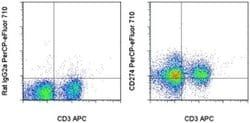
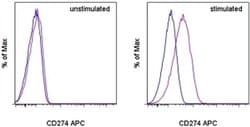
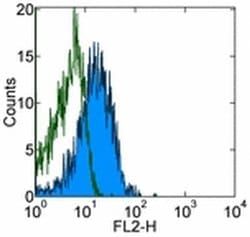
- Applications Tested: This 122 antibody has been tested by flow cytometric analysis of mouse bone marrow derived dendritic cells
- This can be used at less than or equal to 0.5 μg per test
- A test is defined as the amount (μg) of antibody that will stain a cell sample in a final volume of 100 μL
- Cell number should be determined empirically but can range from 10^5 to 10^8 cells/test
- It is recommended that the antibody be carefully titrated for optimal performance in the assay of interest
- Programmed death-ligand 2 (PD-L2), or B7-DC, is a member of the B7 ligand family within the immunoglobulin superfamily that, along with programmed death-ligand 1 (PD-L1), acts as a ligand for programmed cell death protein 1 (PD-1)
- Though expressed primarily in dendritic cells, PD-L2 expression can be induced on a wide variety of immune and non-immune cells depending on the microenvironment
- PD-L2 expression is particularly upregulated in the presence of Th2 cytokine, IL-4, as well as Th1 cytokines, TNF-alpha and IFN-gamma to a lesser degree
- While generally expressed at lower levels compared to PD-L1, PD-L2 demonstrates a 2 to 6 times higher relative affinity to PD-1 than PD-L1
- PD-1 and its ligands are referred to as inhibitory immune checkpoint molecules in that they provide useful negative feedback during physiological homeostasis
- Ligation of PD-L2 or PD-L1 inhibits activation, proliferation, and cytokine secretion (e.g
- IFN-gamma, IL-10) in T cells, μgtimately dampening immune response
- Conversely, studies have shown that PD-L2 can also stimulate T cell proliferation and cytokine production, even in PD-1-deficient T cells, suggesting additional receptors
- Recent studies have concluded that PD-L2 also binds to a second receptor, repulsive guidance molecule b (RGMb), which was originally identified as a receptor for bone morphogenetic proteins (BMPs)
- RGMb is expressed in the central nervous system, as well as in macrophages, however, its role in immunity is only beginning to emerge
- Interaction between PD-L2 and RGMb regulates the development of respiratory tolerance in the lung through BMP and/or neogenin signaling pathways
- The naturally occurring human PD-L2 monomer consists of a 201-amino-acid extracellular domain, a 21-amino-acid transmembrane domain, and a 32-amino-acid cytoplasmic domain.