CD28 Monoclonal Antibody (1C6), Functional Grade, eBioscience™, Invitrogen™
Manufacturer: Fischer Scientific
Select a Size
| Pack Size | SKU | Availability | Price |
|---|---|---|---|
| Each of 1 | 50-112-9763-Each-of-1 | In Stock | ₹ 34,265.00 |
50-112-9763 - Each of 1
In Stock
Quantity
1
Base Price: ₹ 34,265.00
GST (18%): ₹ 6,167.70
Total Price: ₹ 40,432.70
Antigen
CD28
Classification
Monoclonal
Concentration
1 mg/mL
Formulation
PBS with no preservative; pH 7.2
Gene Accession No.
0
Gene Symbols
Cd28
Purification Method
Affinity chromatography
Regulatory Status
RUO
Gene ID (Entrez)
403646
Content And Storage
4° C
Form
Liquid
Applications
Flow Cytometry, Functional Assay
Clone
1C6
Conjugate
Functional Grade
Gene
Cd28
Gene Alias
antigen CD28; CD28; CD28 antigen; CD28 antigen (Tp44); CD28 isoform; CD28 isoform 2; Cd28 molecule; CD28 precursor protein; CD28 protein; CD28 protein precursor; CD28RNA; cell surface protein; CHT28; contains partial extracellular domain; costimulatory molecule B7 receptor CD28; EGK_04709; MGC138290; sCD28; soluble CD28; T44; T-cell costimulatory molecule CD28; T-cell costimulatory molecule Tp44; T-cell-specific surface glycoprotein CD28; T-cell-specific surface glycoprotein CD28 homolog; TP44
Host Species
Mouse
Quantity
100 μg
Primary or Secondary
Primary
Target Species
Canine
Product Type
Antibody
Isotype
IgG1 κ
Related Products



Description
- Description: The 1C6 monoclonal antibody reacts with canine CD28, which is expressed by thymocytes, a majority of T cells, and a subset of NK cells
- CD28 is a ligand for CD80 (B7-1) and CD86 (B7-2) and is a potent costimulator of T cells
- Signaling through CD28 augments IL-2 and IL-2 receptor expression as well as cytotoxicity of CD3-activated T cells
- The 1C6 antibody has been reported to have antagonist activity, as well as induce proliferation
- The 1C6 and 5B8 antibodies recognize different epitopes of canine CD28
- Applications Reported: This 1C6 antibody has been reported for use in flow cytometric analysis and functional assays
- Proliferation assays with the 1C6 antibody are best performed using polypropylene plates
- (Fluorochrome-conjugated 5B8 is recommended for use in flow cytometry.)
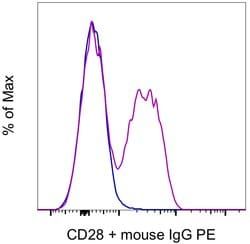
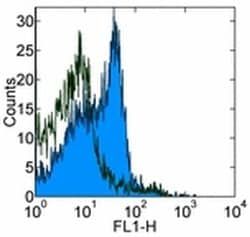
- Applications Tested: This 1C6 antibody has been tested by flow cytometric analysis of normal canine peripheral blood cells
- This can be used at less than or equal to 1 μg per test
- A test is defined as the amount (μg) of antibody that will stain a cell sample in a final volume of 100 μL
- Cell number should be determined empirically but can range from 10^5 to 10^8 cells/test
- It is recommended that the antibody be carefully titrated for optimal performance in the assay of interest
- Endotoxin: Less than 0.001 ng/ug antibody as determined by the LAL assay
- Storage and handling: Use in a sterile environment
- Filtration: 0
- CD28 antigen is a 44 kDa disulfide linked homodimeric T cell specific surface glycoprotein
- CD28 is a cell adhesion molecule of the immunoglobulin superfamily which is constitutively expressed on most peripheral blood T lymphocytes
- Moreover, CD28 is the critical T cell costimulatory receptor that provides the cell the important second activation signal by binding CD80 and CD86 which are expressed by antigen presenting cells
- In addition to its co-stimulation role, CD28 functions by preventing T cells from entering an anergic-hyporesponsive state or from undergoing premature apoptotic cell death
- In murine peripheral lymphoid organs and in the blood, all CD4+ and CD8+ T cells express CD28
- In the thymus, CD28 expression is highest on immature CD3-, CD8+ and CD4+8+ cells, and on CD4-8- cells that express alpha/beta and gamma/delta TCR
- The level of CD28 on mature CD4+ and CD8+ alpha/beta TCR+ thymocytes is two- to fourfold lower than on the immature cells
- Diseases associated with CD28 dysfunction include mycosis fungiodes and Sezary's Disease.