CD10 Monoclonal Antibody (SN5c), Biotin, eBioscience™, Invitrogen™
Manufacturer: Invitrogen
Select a Size
| Pack Size | SKU | Availability | Price |
|---|---|---|---|
| Each of 1 | 50-114-23-Each-of-1 | In Stock | ₹ 16,910.00 |
50-114-23 - Each of 1
In Stock
Quantity
1
Base Price: ₹ 16,910.00
GST (18%): ₹ 3,043.80
Total Price: ₹ 19,953.80
Antigen
CD10
Classification
Monoclonal
Concentration
0.5 mg/mL
Formulation
PBS with 0.09% sodium azide; pH 7.2
Gene Accession No.
P08473
Gene Symbols
Mme
Purification Method
Affinity chromatography
Regulatory Status
RUO
Gene ID (Entrez)
4311
Content And Storage
4° C, store in dark, DO NOT FREEZE!
Form
Liquid
Applications
Flow Cytometry, Immunohistochemistry (Frozen)
Clone
SN5c
Conjugate
Biotin
Gene
Mme
Gene Alias
6030454K05Rik; Atriopeptidase; C85356; CALLA; CD10; CMT2T; common acute lymphoblastic leukemia antigen; common acute lymphocytic leukemia antigen; Enkephalinase; EPN; membrane metallo endopeptidase; membrane metalloendopeptidase; membrane metallo-endopeptidase; membrane metallo-endopeptidase (neutral endopeptidase, enkephalinase, CALLA, CD10); membrane metallo-endopeptidase (neutral endopeptidase/enkephalinase); membrane metallo-endopeptidase variant 1; membrane metallo-endopeptidase variant 2; MME; NEP; neprilysin; neprilysin-390; neprilysin-411; neutral endopeptidase 24.11; SFE; Skin fibroblast elastase
Host Species
Mouse
Quantity
100 μg
Primary or Secondary
Primary
Target Species
Human
Product Type
Antibody
Isotype
IgG1 κ
Related Products

Description
- Description: The eBioSN5c monoclonal antibody recognizes human CD10 (CALLA, NEP, enkephalinase, Neprilysin), which is a 100 kDa, type II cell surface glycoprotein originally identified for its expression on most acute lymphoblastic leukemias (ALLs)
- Subsequently, CD10 was shown to be the same molecule as neutral endopeptidase (NEP), or KII-NA
- CD10 is a Zn^2+-dependent metallopeptidase acting on substrates such as endothelin, glucagon, gastrin, neurotensin and bradykinin
- CD10 is involved in the regulation of chemotactic and inflammatory processes involving neutrophils
- In B cells, CD10 regulates stromal cell-dependent B lymphopoiesis and its expression has been reported on mature germinal center B cells
- CD10 expression is also found on normal donor granulocytes and bone marrow stromal cells
- Most likely, CB-CALLA and eBioSN5c see different epitopes due to their ability to co-stain
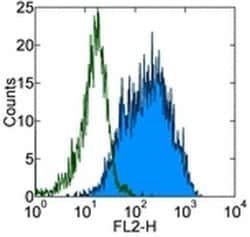
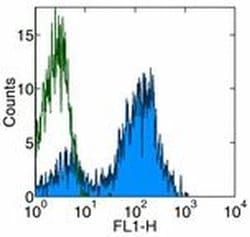
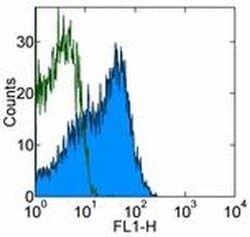
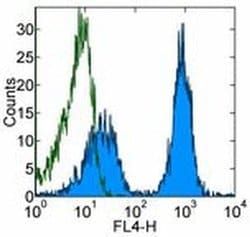
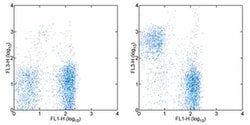
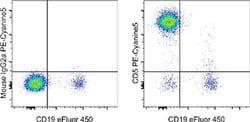
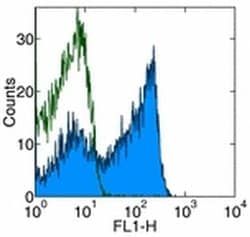
- Applications Reported: This eBioSN5c (SN5c L4-1A1) antibody has been reported for use in flow cytometric analysis, and immunohistology staining of frozen tissue sections
- Applications Tested: This eBioSN5c (SN5c L4-1A1) antibody has been tested by flow cytometric analysis
- This can be used at less than or equal to 0.25 μg per test
- A test is defined as the amount (μg) of antibody that will stain a cell sample in a final volume of 100 μL
- Cell number should be determined empirically but can range from 10^5 to 10^8 cells/test
- CD10 (Common Acute Lymphocytic Leukemia Antigen, CALLA), is a cell surface enzyme with neutral metalloendopeptidase activity which inactivates a variety of biologically active peptides
- CD10 is expressed on the cells of lymphoblastic, Burkitt's, and follicular germinal center lymphomas, immature B cells with in adult bone marrow and on cells from patients with chronic myelocytic leukemia (CML)
- CD10 is also present on breast myoepithelial cells, bile canaliculi, fibroblasts, with especially high expression on the brush border of kidney and gut epithelial cells
- CD10 is a neutral endopeptidase that cleaves peptides at the amino side of hydrophobic residues and inactivates several peptide hormones including glucagon, enkephalins, substance P, neurotensin, oxytocin, and bradykinin
- Further, CD10 is a 100 kDa type II transmembrane glycoprotein that exists in a single copy of greater than 45 kb
- The 5' untranslated region of the CD10 gene is alternatively spliced, resulting in four separate mRNA transcripts and the coding region is not affected by alternative splicing
- Diseases associated with CD10 dysfunction include spinocerebellar ataxia 43 and Charcot-Marie tooth Disease.