CD109 Monoclonal Antibody (HU17), eBioscience™, Invitrogen™
Manufacturer: Invitrogen
Select a Size
| Pack Size | SKU | Availability | Price |
|---|---|---|---|
| Each of 1 | 50-128-19-Each-of-1 | In Stock | ₹ 5,673.75 |
50-128-19 - Each of 1
In Stock
Quantity
1
Base Price: ₹ 5,673.75
GST (18%): ₹ 1,021.275
Total Price: ₹ 6,695.025
Antigen
CD109
Classification
Monoclonal
Concentration
0.5 mg/mL
Formulation
PBS with 0.09% sodium azide; pH 7.2
Gene Accession No.
Q6YHK3
Gene Symbols
CD109
Purification Method
Affinity chromatography
Regulatory Status
RUO
Gene ID (Entrez)
135228
Content And Storage
4° C
Form
Liquid
Applications
Flow Cytometry, Immunoprecipitation
Clone
HU17
Conjugate
Unconjugated
Gene
CD109
Gene Alias
150 kDa TGF-beta-1-binding protein; 9930012E15Rik; activated T-cell marker CD109; AI480638; C3 and PZP-like alpha-2-macroglobulin domain-containing protein 7; Cd109; CD109 antigen; CD109 molecule; CPAMD7; GARP; Gov platelet alloantigens; GPI-anchored alpha 2 macroglobulin-related protein; GPI-anchored alpha-2 macroglobulin-related protein; p180; platelet-specific Gov antigen; r150; RP11-525G3.1
Host Species
Mouse
Quantity
25 μg
Primary or Secondary
Primary
Target Species
Human
Product Type
Antibody
Isotype
IgG1 κ
Related Products


Description
- Description: The HU17 monoclonal antibody reacts with human CD109, also known as the platelet-specific Gov antigen
- CD109, a GPI-anchored monomeric glycoprotein, exists in two isoforms of 120 and 150 kDa, which are proteolytically degraded from a 170 kDa form
- CD109 is expressed on activated T cells, activated platelets and endothelial cells
- CD109 expression is also found on a subset of CD34+ cells in adult and fetal bone marrow which contain megakaryocyte, myeloid, erythroid and multilineage progenitors, as well as pluriopotent hematopoietic stem cells
- Recently, it has been demonstrated that CD109 is expressed on a variety of human cancer cell lines, and also lung and esophogeal cell carcinomas
- In addition, CD109 was recently found to be a negative regulator of TGF-beta in keratinocytes
- Applications Reported: This HU17 antibody has been reported for use in flow cytometric analysis, and immunoprecipitation
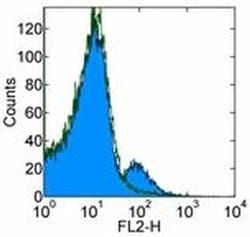
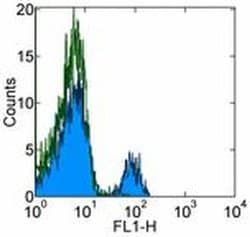
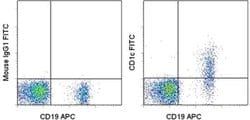
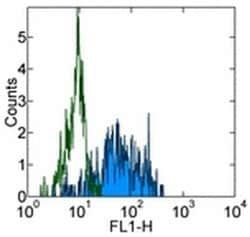
- Applications Tested: This HU17 antibody has been tested by flow cytometric analysis of normal human peripheral blood
- This can be used at less than or equal to 0.25 μg per test
- A test is defined as the amount (μg) of antibody that will stain a cell sample in a final volume of 100 μL
- Cell number should be determined empirically but can range from 10^5 to 10^8 cells/test
- It is recommended that the antibody be carefully titrated for optimal performance in the assay of interest
- CD109 is a member of the alpha2-macroglobulin/complement superfamily
- The encoded GPI-linked glycoprotein is found on the cell surface of platelets, activated T-cells, and endothelial cells
- The protein binds to and negatively regulates signaling of transforming growth factor beta (TGF-beta).