Ub-K63 Monoclonal Antibody (HWA4C4), eBioscience™, Invitrogen™
Manufacturer: Fischer Scientific
Select a Size
| Pack Size | SKU | Availability | Price |
|---|---|---|---|
| Each of 1 | 50-134-54-Each-of-1 | In Stock | ₹ 37,380.00 |
50-134-54 - Each of 1
In Stock
Quantity
1
Base Price: ₹ 37,380.00
GST (18%): ₹ 6,728.40
Total Price: ₹ 44,108.40
Antigen
Ub-K63
Classification
Monoclonal
Concentration
0.5 mg/mL
Formulation
PBS with 0.09% sodium azide; pH 7.2
Gene Accession No.
P0CG47, P0CG48, P62979, P62987
Gene Symbols
RPS27A, UBA52, UBB, UBC
Purification Method
Affinity chromatography
Regulatory Status
RUO
Gene ID (Entrez)
6233, 7311, 7314, 7316
Content And Storage
4° C
Form
Liquid
Applications
Western Blot
Clone
HWA4C4
Conjugate
Unconjugated
Gene
UBC
Gene Alias
0610006J14Rik; 2700054O04Rik; 40S ribosomal protein S27a; 60S ribosomal protein L40; AI194771; AL033289; CEP52; CEP80; D8Ertd21e; epididymis luminal protein 112; epididymis secretory protein Li 50; Gm1863; HEL112; HEL-S-50; HMG20; HUBCEP52; L40; Large ribosomal subunit protein eL40; LOC100912032; polyubiquitin B; polyubiquitin C; polyubiquitin-B; Polyubiquitin-C; ribosomal protein S27A; RPL40; Rps27a; S27A; Small ribosomal subunit protein eS31; TI-225; Uba52; UBA80; Ubb; Ubb2; UBC; UBCEP1; UBCEP2; UBCEP80; Ubiquitin; Ubiquitin A-52 residue ribosomal protein fusion product 1; ubiquitin and ribosomal protein S27a; ubiquitin B; ubiquitin C; ubiquitin carboxyl extension protein 52; ubiquitin carboxyl extension protein 80; ubiquitin/60S ribosomal fusion protein; Ubiquitin-40S ribosomal protein S27a; ubiquitin-40S ribosomal protein S27a-like; ubiquitin-52 amino acid fusion protein; ubiquitin-60S ribosomal protein L40; ubiquitin-CEP52; ubiquitin-CEP80; Ubiquitin-related; Ubiquitin-related 1; Ubiquitin-related 2
Host Species
Mouse
Quantity
100 μg
Primary or Secondary
Primary
Target Species
Human
Product Type
Antibody
Isotype
IgG2a
Related Products

Description
- Description: Ubiquitin is a highly conserved 76kDa protein which is ligated to many proteins in both monomeric and polymeric forms
- Ubiquitin polymers (polyubiquitin) can be found in several varieties depending on which of its 7 lysine residues is the site of ligation
- The two most common polymer chains are linked via an isopeptide bond between glycine-76 and either lysine-48 (K-48) or lysine-63 (K-63)
- K-48-linked polyubiquitination typically results in targeting the protein to the 26S proteosome resulting in proteolysis, although recently exceptions to this have been observed
- In contrast, K-63-linked polyubiquitination results in signals related to intracellular trafficking, cell signaling, ribosomal biogenesis, and DNA damage repair
- There are also reports that K63-linked polyubiquitin is involved in proteosome-independent proteolysis via autophagy
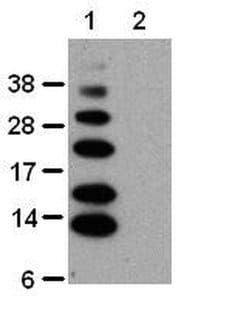
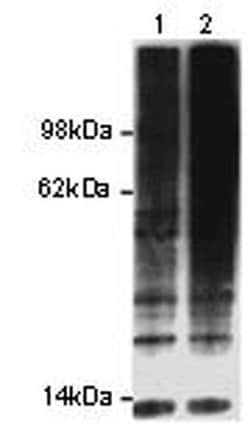
- HWA4C4 reacts specifically with the isopeptide linkage region of lysine-63-linked polyubiquitin
- It does not react with other forms of ubiquitin including ubiquitin monomer and lysine-48-linked chains
- Applications Reported: This HWA4C4 antibody has been reported for use in immunoblotting (WB)
- Applications Tested: This HWA2-8°C4 antibody has been tested by immunoblot of lysine-63-linked polyubiquitin chains
- This can be used at less than or equal to 2 μg/mL
- It is recommended that the antibody be carefully titrated for optimal performance in the assay of interest
- Ubiquitin is a conserved 76 amino acid polypeptide and can affect proteasomal degradation of the protein it is bound to, or mediate interactions with other proteins related to post-translational modifications
- The degradation of cellular regulatory proteins by the Uubiquitin pathway is important as it controls the cellular growth and proliferation
- Ubiquitin-dependent proteolysis occurs after a covalent attachment of the peptide to a lysine residue of a protein, which involves three enzymatic reactions: E1, E2 and E3
- The first reaction involves ubiquitin-activating enzyme
- The third reaction uses enzyme ubiquitin ligase (E3) to transfer the activated ubiquitin from E2 to a lysine residue on a protein, or directly transfers the ubiquitin from E2 to the substrate.