50-153-13
CD217 (IL-17Ra) Monoclonal Antibody (PAJ-17R), APC, eBioscience™, Invitrogen™
Manufacturer: Fischer Scientific
Select a Size
| Pack Size | SKU | Availability | Price |
|---|---|---|---|
| Each of 1 | 50-153-13-Each-of-1 | In Stock | ₹ 14,774.00 |
50-153-13 - Each of 1
In Stock
Quantity
1
Base Price: ₹ 14,774.00
GST (18%): ₹ 2,659.32
Total Price: ₹ 17,433.32
Antigen
CD217 (IL-17Ra)
Classification
Monoclonal
Concentration
0.2 mg/mL
Formulation
PBS with 0.09% sodium azide; pH 7.2
Gene Accession No.
Q60943
Gene Symbols
Il17ra
Purification Method
Affinity chromatography
Regulatory Status
RUO
Gene ID (Entrez)
16172
Content And Storage
4° C, store in dark, DO NOT FREEZE!
Form
Liquid
Applications
Flow Cytometry
Clone
PAJ-17R
Conjugate
APC
Gene
Il17ra
Gene Alias
AW538159; CANDF5; CD127; CD217; CDw217; hIL-17R; IL-17 receptor A; IL17R; Il17ra; IL-17RA; interleukin 17 receptor A; interleukin-17 receptor A; MGC10262; VDw217
Host Species
Rat
Quantity
25 μg
Primary or Secondary
Primary
Target Species
Mouse
Product Type
Antibody
Isotype
IgG2a
Related Products


Description
- Description: The monoclonal antibody PAJ-17R recognizes mouse IL-17 receptor A (IL-17RA) also known as CD217
- This single transmembrane domain-containing receptor can homo- or heterodimerize with IL-17RC or IL-17RB
- IL-17RA binds to IL-17A, IL-17F(cytokines of the Th 17 lineage), or IL-17E (IL-25)
- Ligand binding to the single subunit of IL-17RA has been shown to induce homo- or heterodimerization of the receptor complex that in turn recruits Act-1 via the SEFIR domains leading to recruitment of TRAF6 and signaling through the NFkappaB and MAPK pathways
- Initial reports suggested ubiquitous expression of IL-17RA based on binding studies with IL-17-Fc and expression of mRNA
- Interestingly, despite this, not all cells expressing the receptor respond to IL-17A
- In particular, resting T cells do not respond
- It is not known if the expression level of IL-17RA protein varies or if some cells express the receptor but are not able to activate downstream signaling events
- Recent evidence suggests a more limited expression profile based on IL-17RA knock-out mice which display decreased numbers of neutrophils with impaired function in response to challenge with K
- pneumonia or Candida albicans
- This suggests IL-17RA plays a more domit and critical role in neutrophil development and function
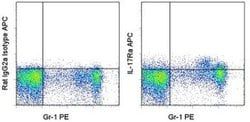
- Our studies suggest that expression can be found on abundantly on Gr-1^dim population and many of the Gr-1^bright bone marrow cells, as well as some F4/80 positive cells
- Interleukin 17A (IL-17A) is a proinflammatory cytokine secreted by activated T-lymphocytes
- It is a potent inducer of the maturation of CD34-positive hematopoietic precursors into neutrophils
- IL-17RA is a ubiquitous type I membrane glycoprotein that binds with low affinity to IL-17A and IL-17F
- IL-17A and its receptor play a pathogenic role in many inflammatory and autoimmune diseases such as rheumatoid arthritis
- Defects in IL-17RA are the cause of familial candidiasis type 5 (CANDF5) which is a rare disorder with altered immune responses and impaired clearance of fungal infections.