50-155-6909
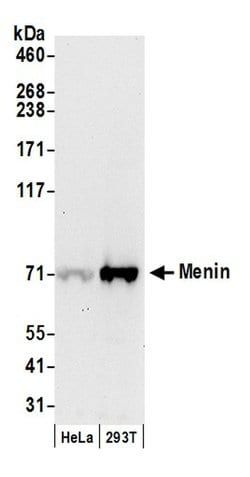
Menin Polyclonal Antibody, Bethyl Laboratories
Manufacturer: Bethyl Laboratories, Inc
Select a Size
| Pack Size | SKU | Availability | Price |
|---|---|---|---|
| Each of 1 | 50-155-6909-Each-of-1 | In Stock | ₹ 12,384.35 |
50-155-6909 - Each of 1
In Stock
Quantity
1
Base Price: ₹ 12,384.35
GST (18%): ₹ 2,229.183
Total Price: ₹ 14,613.533
Antigen
Menin
Classification
Polyclonal
Formulation
TBS with 0.1% BSA and 0.09% sodium azide
Gene Accession No.
O00255, O88559
Gene Symbols
MEN1
Immunogen
Between 575 and C-term
Quantity
20 μL
Primary or Secondary
Primary
Target Species
Human, Mouse
Product Type
Antibody
Isotype
IgG
Applications
Immunohistochemistry, Western Blot
Conjugate
Unconjugated
Gene
MEN1
Gene Alias
MEAI, menin, multiple endocrine neoplasia I, SCG2
Host Species
Rabbit
Purification Method
Antigen affinity chromatography
Regulatory Status
RUO
Gene ID (Entrez)
17283, 4221
Content And Storage
4° C
Form
Liquid
Related Products




Description
- The recommended shelf life for this product is 1 year from date of receipt
- Application Note: For IHC, epitope retrieval with Tris-EDTA pH 9.0 is recommended for FFPE tissue sections
- Based on 100% sequence identity, this antibody is predicted to react with Rat, Bovine and Dog Menin is a putative tumor suppressor associated with a syndrome known as multiple endocrine neoplasia type 1
- In vitro studies have shown menin is localized to the nucleus, possesses two functional nuclear localization signals, and inhibits transcriptional activation by JunD, however, the function of this protein is not known
- Two messages have been detected on northern blots but the larger message has not been characterized
- Two variants of the shorter transcript have been identified where alternative splicing affects the CDS
- Five variants where alternative splicing takes place in the 5′ UTR have also been identified.