50-155-6939
MCM2 Goat anti-Human, Mouse, Polyclonal, Bethyl Laboratories
Manufacturer: Bethyl Laboratories, Inc
Select a Size
| Pack Size | SKU | Availability | Price |
|---|---|---|---|
| Each of 1 | 50-155-6939-Each-of-1 | In Stock | ₹ 43,546.81 |
50-155-6939 - Each of 1
In Stock
Quantity
1
Base Price: ₹ 43,546.81
GST (18%): ₹ 7,838.426
Total Price: ₹ 51,385.236
Antigen
MCM2
Classification
Polyclonal
Conjugate
Unconjugated
Gene
MCM2
Gene Alias
minichromosome maintece complex component 2
Host Species
Goat
Purification Method
Antigen affinity chromatography
Regulatory Status
RUO
Gene ID (Entrez)
17216, 4171
Content And Storage
4° C
Form
Liquid
Applications
Western Blot
Concentration
1 mg/ml
Formulation
phosphate, tris citrate with 0.09% sodium azide; pH 7-8
Gene Accession No.
P49736, P97310
Gene Symbols
MCM2
Immunogen
Between 1 and 50
Quantity
100 μL
Primary or Secondary
Primary
Target Species
Human, Mouse
Product Type
Antibody
Isotype
IgG
Related Products
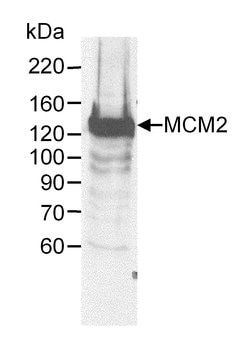

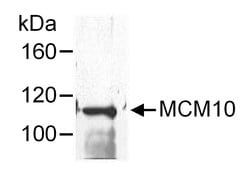


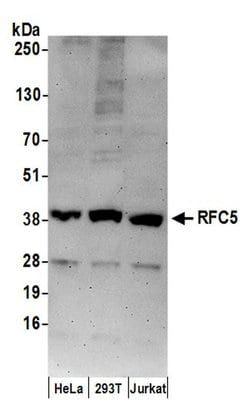
Description
- The recommended shelf life for this product is 1 year from date of receipt
- Based on 100% sequence identity, this antibody is predicted to react with Orangutan, Gorilla and Chimpanzee MCM2 (Mini chromosome maintece protein 2) is involved in regulating DNA replication
- MCM2 (also called CDCL1, mitotin and BM28), is a human nuclear protein that is crucial in the cell cycle, being involved in the onset of DNA replication and cell division
- It is similar to members of the family of early S-phase proteins
- Mincheva et al
- (1994) mapped the gene to 3q21
- From its localization, CDCL1 became a candidate for an oncogene affected by chromosomal breaks in acute myeloid leukemia (AML).