50-155-6997
Phospho-Rad17 (Ser645) Rabbit anti-Human, Mouse, Polyclonal, Bethyl Laboratories
Manufacturer: Bethyl Laboratories, Inc
Select a Size
| Pack Size | SKU | Availability | Price |
|---|---|---|---|
| Each of 1 | 50-155-6997-Each-of-1 | In Stock | ₹ 46,362.77 |
50-155-6997 - Each of 1
In Stock
Quantity
1
Base Price: ₹ 46,362.77
GST (18%): ₹ 8,345.299
Total Price: ₹ 54,708.069
Antigen
Phospho-Rad17 (Ser645)
Classification
Polyclonal
Conjugate
Unconjugated
Gene
RAD17
Gene Alias
CCYC, FLJ41520, HRAD17, R24L, RAD17SP, RAD24
Host Species
Rabbit
Purification Method
Antigen affinity chromatography
Regulatory Status
RUO
Gene ID (Entrez)
19356, 5884
Content And Storage
4° C
Form
Liquid
Applications
Immunohistochemistry, Western Blot
Concentration
1 mg/ml
Formulation
phosphate, tris citrate with 0.09% sodium azide; pH 7-8
Gene Accession No.
O75943, Q6NXW6
Gene Symbols
RAD17
Immunogen
Surrounding serine 645
Quantity
100 μL
Primary or Secondary
Primary
Target Species
Human, Mouse
Product Type
Antibody
Isotype
IgG
Related Products

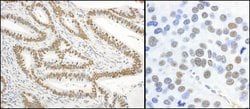


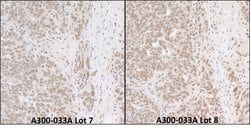


Description
- The recommended shelf life for this product is 1 year from date of receipt
- Application Note: For IHC, epitope retrieval with citrate buffer pH 6.0 is recommended for FFPE tissue sections
- Based on 100% sequence identity, this antibody is predicted to react with Orangutan Rad17 is essential for sustained cell growth, maintece of chromosomal stability, and ATR-dependent checkpoint activation upon DNA damage
- It has a weak ATPase activity required for binding to chromatin
- Rad17 also participates in the recruitment of the RAD1-RAD9-HUS1 complex and RHNO1 onto chromatin, and in CHEK1 activation
- May also serve as a sensor of DNA replication progression, and may be involved in homologous recombination.