50-155-7555
TBLR1 Rabbit anti-Human, Mouse, Polyclonal, Bethyl Laboratories
Manufacturer: Bethyl Laboratories, Inc
Select a Size
| Pack Size | SKU | Availability | Price |
|---|---|---|---|
| Each of 1 | 50-155-7555-Each-of-1 | In Stock | ₹ 43,546.81 |
50-155-7555 - Each of 1
In Stock
Quantity
1
Base Price: ₹ 43,546.81
GST (18%): ₹ 7,838.426
Total Price: ₹ 51,385.236
Antigen
TBLR1
Classification
Polyclonal
Conjugate
Unconjugated
Gene
TBL1XR1
Gene Alias
C21, DC42, FLJ12894, IRA1, TBLR1
Host Species
Rabbit
Purification Method
Antigen affinity chromatography
Regulatory Status
RUO
Gene ID (Entrez)
79718, 81004
Content And Storage
4° C
Form
Liquid
Applications
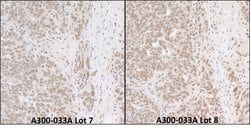
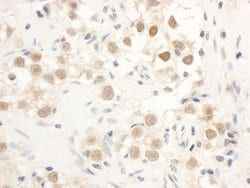
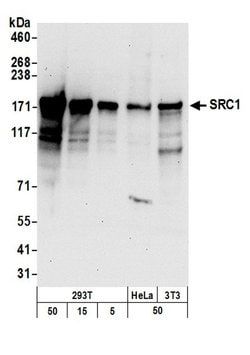
Immunohistochemistry, Immunoprecipitation, Western Blot
Concentration
1 mg/ml
Formulation
phosphate, tris citrate with 0.09% sodium azide; pH 7-8
Gene Accession No.
Q8BHJ5, Q9BZK7
Gene Symbols
Tbl1xr1
Immunogen
Between 100 and 150
Quantity
100 μL
Primary or Secondary
Primary
Target Species
Human, Mouse
Product Type
Antibody
Isotype
IgG
Related Products





Description
- The recommended shelf life for this product is 1 year from date of receipt
- Application Note: For IHC, epitope retrieval with citrate buffer pH 6.0 is recommended for FFPE tissue sections
- The protein encoded by this gene has sequence similarity with members of the WD40 repeat-containing protein family
- The WD40 group is a large family of proteins, which appear to have a regulatory function
- It is believed that the WD40 repeats mediate protein-protein interactions and members of the family are involved in signal transduction, RNA processing, gene regulation, vesicular trafficking, cytoskeletal assembly and may play a role in the control of cytotypic differentiation.