50-155-7917
RPS6 Polyclonal Antibody, Bethyl Laboratories
Manufacturer: Bethyl Laboratories, Inc
Select a Size
| Pack Size | SKU | Availability | Price |
|---|---|---|---|
| Each of 1 | 50-155-7917-Each-of-1 | In Stock | ₹ 12,384.35 |
50-155-7917 - Each of 1
In Stock
Quantity
1
Base Price: ₹ 12,384.35
GST (18%): ₹ 2,229.183
Total Price: ₹ 14,613.533
Antigen
RPS6
Classification
Polyclonal
Formulation
TBS with 0.1% BSA and 0.09% sodium azide
Gene Accession No.
P62753, P62754
Gene Symbols
Rps6
Immunogen
Between 200 and C-term
Quantity
20 μL
Primary or Secondary
Primary
Target Species
Human, Mouse
Product Type
Antibody
Isotype
IgG
Applications
Immunohistochemistry, Western Blot
Conjugate
Unconjugated
Gene
RPS6
Gene Alias
RP11-513M16.6
Host Species
Rabbit
Purification Method
Antigen affinity chromatography
Regulatory Status
RUO
Gene ID (Entrez)
20104, 6194
Content And Storage
4° C
Form
Liquid
Related Products



Description
- The recommended shelf life for this product is 1 year from date of receipt
- Application Note: For IHC, epitope retrieval with citrate buffer pH 6.0 is recommended for FFPE tissue sections
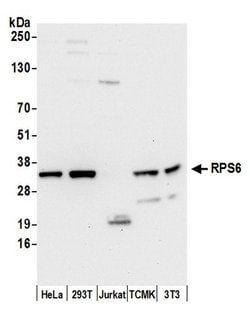
- Based on 100% sequence identity, this antibody is predict Ribosomal protein S6 is a component of the small 40S ribosomeal subunit and belongs to the S6E family of ribosomal proteins
- It is the major substrate of protein kinases in the ribosome, with subsets of five C-terminal serine residues phosphorylated by different protein kinases
- Phosphorylation is induced by a wide range of stimuli, including growth factors, tumor-promoting agents, and mitogens
- Dephosphorylation occurs at growth arrest
- The protein may contribute to the control of cell growth and proliferation through the selective translation of particular classes of mRNA
- As is typical for genes encoding ribosomal proteins, there are multiple processed pseudogenes of this gene dispersed through the genome.