50-157-1517
ADNP Polyclonal Antibody, Bethyl Laboratories
Manufacturer: Fischer Scientific
Select a Size
| Pack Size | SKU | Availability | Price |
|---|---|---|---|
| Each of 1 | 50-157-1517-Each-of-1 | In Stock | ₹ 46,161.63 |
50-157-1517 - Each of 1
In Stock
Quantity
1
Base Price: ₹ 46,161.63
GST (18%): ₹ 8,309.093
Total Price: ₹ 54,470.723
Antigen
ADNP
Classification
Polyclonal
Formulation
TBS with 0.1% BSA and 0.09% sodium azide
Gene Accession No.
Q9H2P0
Gene Symbols
ADNP
Immunogen
Between 1050 and C-term
Quantity
100 μL
Primary or Secondary
Primary
Target Species
Human
Product Type
Antibody
Isotype
IgG
Applications
Immunohistochemistry
Conjugate
Unconjugated
Gene
ADNP
Gene Alias
Activity dependent neuroprotector, KIAA0784
Host Species
Rabbit
Purification Method
Antigen affinity chromatography
Regulatory Status
RUO
Gene ID (Entrez)
23394
Content And Storage
4° C
Form
Liquid
Related Products
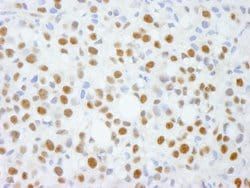
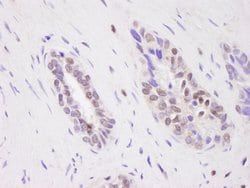
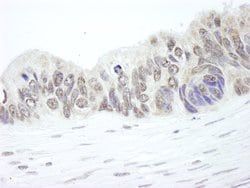
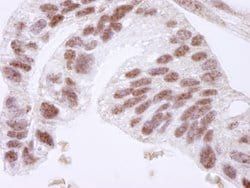

Description
- The recommended shelf life for this product is 1 year from date of receipt
- Based on 100% sequence identity, this antibody is predicted to react with Orangutan, Monkey, Gorilla, Chimpanzee, Northern white-cheeked gibbon, Small-eared galago and Cra Vasoactive intestinal peptide is a neuroprotective factor that has a stimulatory effect on the growth of some tumor cells and an inhibitory effect on others
- This gene encodes a protein that is upregulated by vasoactive intestinal peptide and may be involved in its stimulatory effect on certain tumor cells
- The encoded protein contains one homeobox and nine zinc finger domains, suggesting that it functions as a transcription factor
- This gene is also upregulated in normal proliferative tissues
- Finally, the encoded protein may increase the viability of certain cell types through modulation of p53 activity
- Alternatively spliced transcript variants encoding the same protein have been described.