50-157-1539
BAF57/SMARCE1 Polyclonal Antibody, Bethyl Laboratories
Manufacturer: Fischer Scientific
Select a Size
| Pack Size | SKU | Availability | Price |
|---|---|---|---|
| Each of 1 | 50-157-1539-Each-of-1 | In Stock | ₹ 46,161.63 |
50-157-1539 - Each of 1
In Stock
Quantity
1
Base Price: ₹ 46,161.63
GST (18%): ₹ 8,309.093
Total Price: ₹ 54,470.723
Antigen
BAF57/SMARCE1
Classification
Polyclonal
Formulation
TBS with 0.1% BSA and 0.09% sodium azide
Gene Accession No.
O54941, Q969G3
Gene Symbols
Smarce1
Immunogen
Between 360 and C-term
Quantity
100 μL
Primary or Secondary
Primary
Target Species
Human, Mouse
Product Type
Antibody
Isotype
IgG
Applications
Immunohistochemistry
Conjugate
Unconjugated
Gene
SMARCE1
Gene Alias
SMARCE1; BAF57; SWI/SNF related, matrix associated, actin dependent regulator of chromatin, subfamily e, member 1; mammalian chromatin remodeling complex BRG1-associated factor 57; BAF57; SWI/SNF-related matrix-associated actin-dependent regulator of chromatin e1
Host Species
Rabbit
Purification Method
Antigen affinity chromatography
Regulatory Status
RUO
Gene ID (Entrez)
57376, 6605
Content And Storage
4° C
Form
Liquid
Related Products
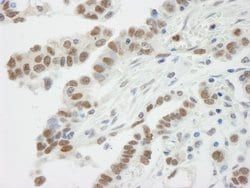
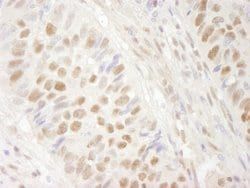
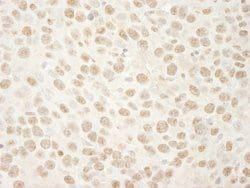
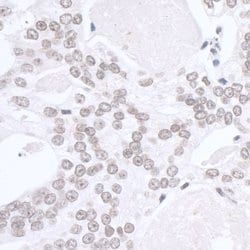
Description
- The recommended shelf life for this product is 1 year from date of receipt
- The protein encoded by this gene is part of the large ATP-dependent chromatin remodeling complex SWI/SNF, which is required for transcriptional activation of genes normally repressed by chromatin
- The encoded protein, either alone or when in the SWI/SNF complex, can bind to 4-way junction DNA, which is thought to mimic the topology of DNA as it enters or exits the nucleosome
- The protein contains a DNA-binding HMG domain, but disruption of this domain does not abolish the DNA-binding or nucleosome-displacement activities of the SWI/SNF complex
- Unlike most of the SWI/SNF complex proteins, this protein has no yeast counterpart.