50-157-2063
RFC3 Polyclonal Antibody, Bethyl Laboratories
Manufacturer: Fischer Scientific
Select a Size
| Pack Size | SKU | Availability | Price |
|---|---|---|---|
| Each of 1 | 50-157-2063-Each-of-1 | In Stock | ₹ 46,161.63 |
50-157-2063 - Each of 1
In Stock
Quantity
1
Base Price: ₹ 46,161.63
GST (18%): ₹ 8,309.093
Total Price: ₹ 54,470.723
Antigen
RFC3
Classification
Polyclonal
Formulation
TBS with 0.1% BSA and 0.09% sodium azide
Gene Accession No.
P40938
Gene Symbols
RFC3
Immunogen
Between 80 and 110
Quantity
100 μL
Primary or Secondary
Primary
Target Species
Human
Product Type
Antibody
Isotype
IgG
Applications
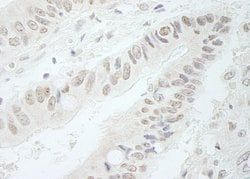
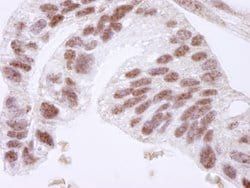
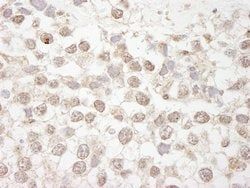
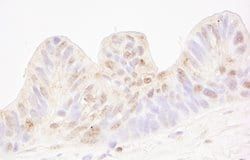
Immunohistochemistry
Conjugate
Unconjugated
Gene
RFC3
Gene Alias
MGC5276, RFC38
Host Species
Rabbit
Purification Method
Antigen affinity chromatography
Regulatory Status
RUO
Gene ID (Entrez)
5983
Content And Storage
4° C
Form
Liquid
Related Products
Description
- The recommended shelf life for this product is 1 year from date of receipt
- Based on 100% sequence identity, this antibody is predicted to react with Mouse, Rat, Zebrafish, X
- laevis, X
- tropicalis, Bovine, Dog, Horse, Rabbit, Guinea pig_10 The elongation of primed DNA templates by DNA polymerase delta and DNA polymerase epsilon requires the accessory proteins proliferating cell nuclear antigen (PCNA) and replication factor C (RFC)
- RFC, also named activator 1, is a protein complex consisting of five distinct subunits of 140, 40, 38, 37, and 36 kDa
- This gene encodes the 38 kDa subunit
- This subunit is essential for the interaction between the 140 kDa subunit and the core complex that consists of the 36, 37, and 40 kDa subunits
- Alternatively spliced transcript variants encoding distinct isoforms have been described.