50-166-6356
PLOD2 Mouse anti-Human, Clone: OTI1A12, lyophilized, TrueMAB™
Manufacturer: OriGene
Select a Size
| Pack Size | SKU | Availability | Price |
|---|---|---|---|
| Each of 1 | 50-166-6356-Each-of-1 | In Stock | ₹ 60,342.00 |
50-166-6356 - Each of 1
In Stock
Quantity
1
Base Price: ₹ 60,342.00
GST (18%): ₹ 10,861.56
Total Price: ₹ 71,203.56
Antigen
PLOD2
Classification
Monoclonal
Conjugate
Unconjugated
Gene
PLOD2
Gene Alias
BRKS2, LH2, TLH
Host Species
Mouse
Purification Method
Affinity Chromatography
Regulatory Status
RUO
Gene ID (Entrez)
5352
Content And Storage
-20° C, Avoid Freeze/Thaw Cycles
Form
Lyophilized
Applications
Western Blot
Clone
OTI1A12
Formulation
PBS with 8% trehalose and no preservative; pH 7.3
Gene Accession No.
O00469
Gene Symbols
PLOD2
Immunogen
Human recombit protein fragment corresponding to amino acids 359-640 of human PLOD2 produced in E.coli.
Quantity
100 μg
Primary or Secondary
Primary
Target Species
Human
Product Type
Antibody
Isotype
IgG1
Related Products
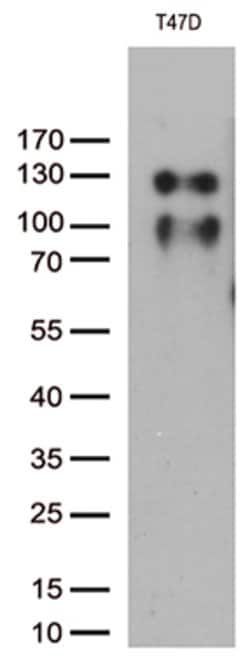
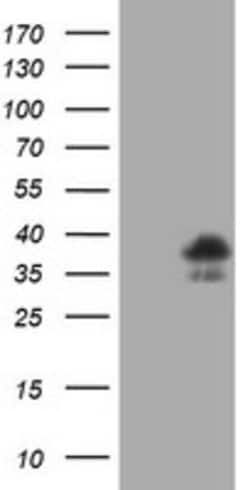
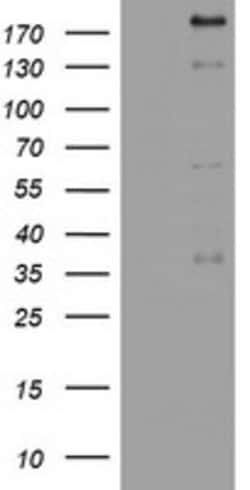
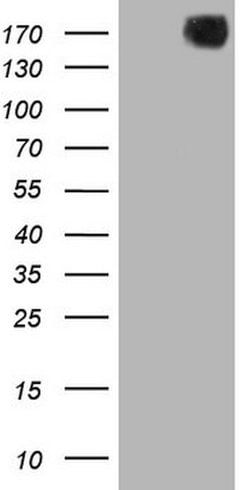
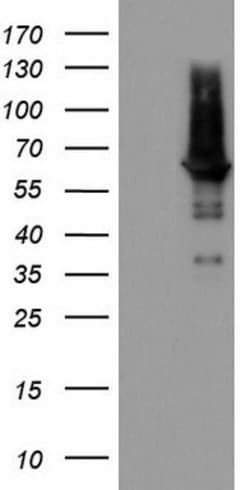
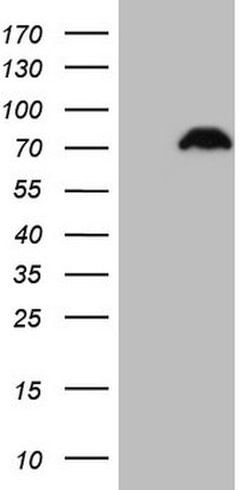
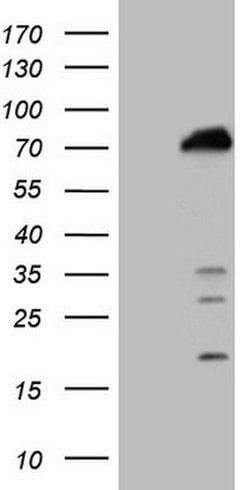
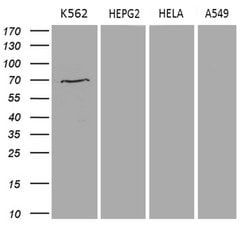
Description
- Reconstitute with PBS (pH 7.3) and recommend to perform another round of desalting process using Product No
- 7KMWCO The protein encoded by this gene is a membrane-bound homodimeric enzyme that is localized to the cisternae of the rough endoplasmic reticulum
- The enzyme (cofactors iron and ascorbate) catalyzes the hydroxylation of lysyl residues in collagen-like peptides
- The resultant hydroxylysyl groups are attachment sites for carbohydrates in collagen and thus are critical for the stability of intermolecular crosslinks
- Some patients with Ehlers-Danlos syndrome type VIB have deficiencies in lysyl hydroxylase activity
- Mutations in the coding region of this gene are associated with Bruck syndrome
- Alternative splicing results in multiple transcript variants encoding different isoforms.