50-166-8444
CDCA8 Mouse anti-Human, Clone: OTI4G3, lyophilized, TrueMAB™
Manufacturer: OriGene
Select a Size
| Pack Size | SKU | Availability | Price |
|---|---|---|---|
| Each of 1 | 50-166-8444-Each-of-1 | In Stock | ₹ 60,342.00 |
50-166-8444 - Each of 1
In Stock
Quantity
1
Base Price: ₹ 60,342.00
GST (18%): ₹ 10,861.56
Total Price: ₹ 71,203.56
Antigen
CDCA8
Classification
Monoclonal
Conjugate
Unconjugated
Gene
CDCA8
Gene Alias
BOR, BOREALIN, DasraB, MESRGP
Host Species
Mouse
Purification Method
Affinity Chromatography
Regulatory Status
RUO
Gene ID (Entrez)
55143
Content And Storage
-20° C, Avoid Freeze/Thaw Cycles
Form
Lyophilized
Applications
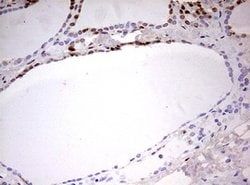
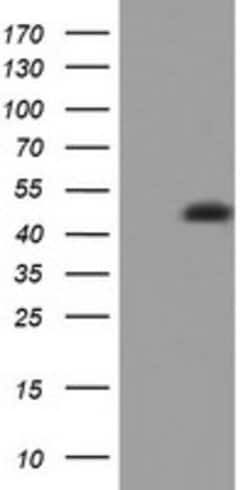
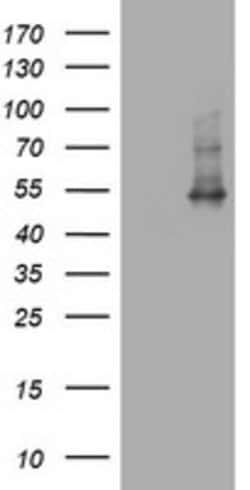
Immunohistochemistry (Paraffin), Western Blot
Clone
OTI4G3
Formulation
PBS with 8% trehalose and no preservative; pH 7.3
Gene Accession No.
Q53HL2
Gene Symbols
CDCA8
Immunogen
Full length human recombit protein of human CDCA8 produced in E.coli.
Quantity
100 μg
Primary or Secondary
Primary
Target Species
Human
Product Type
Antibody
Isotype
IgG1
Related Products
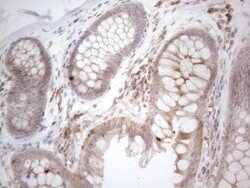

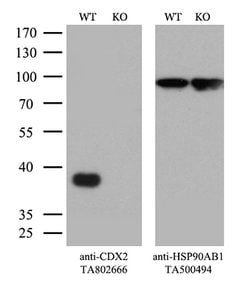
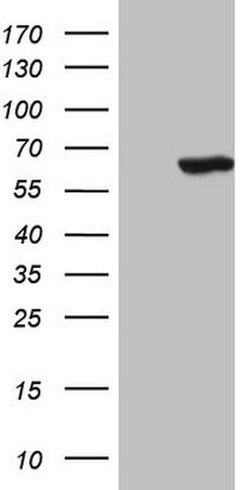
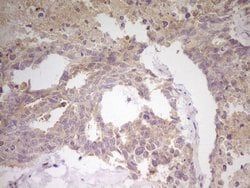
Description
- Reconstitute with PBS (pH 7.3) and recommend to perform another round of desalting process using Product No
- 7KMWCO CDCA8 is a component of a chromosomal passenger complex (CPC) required for stability of the bipolar mitotic spindle
- The chromosomal passenger complex, which includes Survivin, CDCA8, INCENP and Aurora-B, is known to play crucial roles during mitosis and cell division
- It was found that CDCA8 interacting with Aurora-B, INCENP and Survivin, increases during G2/M phase and then reduces after exit from M phase
- CDCA8 is cell cycle regulated, down-regulated in response to p53/Rb-signaling, and up-regulated in many types of cancerous tissues
- In Drosophila cells, inactivation of CDCA8 results in polyploidy, delayed mitosis and abnormal tissue development, indicating its critical role for cell proliferation
- Recent studies show that CDCA8 is essential for cell proliferation during early embryonic development, and its early embryonic lethality cannot be rescued by the loss of p53
- Its aberrant expression is linked to a poor prognosis for gastric cancer.