50-167-4209
PSMD2 Mouse anti-Canine, Human, Mouse, Rat, Clone: OTI1G8, liquid, TrueMAB™
Manufacturer: OriGene
Select a Size
| Pack Size | SKU | Availability | Price |
|---|---|---|---|
| Each of 1 | 50-167-4209-Each-of-1 | In Stock | ₹ 20,470.00 |
50-167-4209 - Each of 1
In Stock
Quantity
1
Base Price: ₹ 20,470.00
GST (18%): ₹ 3,684.60
Total Price: ₹ 24,154.60
Antigen
PSMD2
Classification
Monoclonal
Concentration
0.58 mg/mL
Formulation
PBS with 1% BSA, 50% glycerol and 0.02% sodium azide
Gene Accession No.
Q13200, Q4FZT9, Q8VDM4
Gene Symbols
Psmd2
Immunogen
Full length human recombit protein of human PSMD2 produced in HEK293T cell.
Quantity
30 μL
Primary or Secondary
Primary
Target Species
Canine, Human, Mouse, Rat
Product Type
Antibody
Isotype
IgG2a
Applications
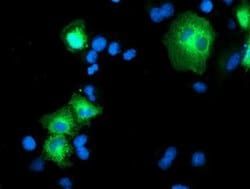
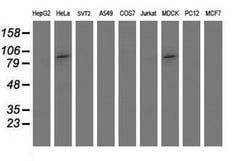
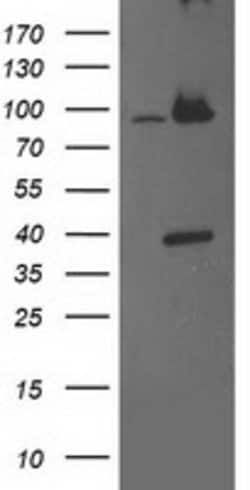
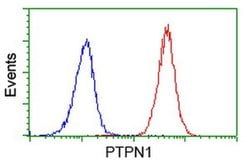
Immunocytochemistry, Immunofluorescence, Western Blot
Clone
OTI1G8
Conjugate
Unconjugated
Gene
PSMD2
Gene Alias
P97, RPN1, S2, TRAP2
Host Species
Mouse
Purification Method
Affinity Chromatography
Regulatory Status
RUO
Gene ID (Entrez)
21762, 287984, 478654, 5708
Content And Storage
-20° C, Avoid Freeze/Thaw Cycles
Form
Liquid
Related Products

Description
- The 26S proteasome is a multicatalytic proteinase complex with a highly ordered structure composed of 2 complexes, a 20S core and a 19S regulator
- The 20S core is composed of 4 rings of 28 non-identical subunits; 2 rings are composed of 7 alpha subunits and 2 rings are composed of 7 beta subunits
- The 19S regulator is composed of a base, which contains 6 ATPase subunits and 2 non-ATPase subunits, and a lid, which contains up to 10 non-ATPase subunits
- Proteasomes are distributed throughout eukaryotic cells at a high concentration and cleave peptides in an ATP/ubiquitin-dependent process in a non-lysosomal pathway
- An essential function of a modified proteasome, the immunoproteasome, is the processing of class I MHC peptides
- This gene encodes one of the non-ATPase subunits of the 19S regulator lid
- In addition to participation in proteasome function, this subunit may also participate in the TNF signalling pathway since it interacts with the tumor necrosis factor type 1 receptor
- A pseudogene has been identified on chromosome 1.