50-167-8032
TRIM9 Monoclonal Antibody (OTI1G10), TrueMAB™, OriGene
Manufacturer: OriGene
Select a Size
| Pack Size | SKU | Availability | Price |
|---|---|---|---|
| Each of 1 | 50-167-8032-Each-of-1 | In Stock | ₹ 44,954.79 |
50-167-8032 - Each of 1
In Stock
Quantity
1
Base Price: ₹ 44,954.79
GST (18%): ₹ 8,091.862
Total Price: ₹ 53,046.652
Antigen
TRIM9
Classification
Monoclonal
Concentration
1 mg/mL
Formulation
PBS with 1% BSA, 50% glycerol and 0.02% sodium azide
Gene Accession No.
Q9C026
Gene Symbols
TRIM9
Immunogen
Human recombit protein fragment corresponding to amino acids 284-669 of human TRIM9 produced in E.coli.
Quantity
100 μL
Primary or Secondary
Primary
Target Species
Human
Product Type
Antibody
Isotype
IgG2b
Applications
Flow Cytometry, Immunocytochemistry, Immunofluorescence, Western Blot
Clone
OTI1G10
Conjugate
Unconjugated
Gene
TRIM9
Gene Alias
RNF91, SPRING
Host Species
Mouse
Purification Method
Affinity Chromatography
Regulatory Status
RUO
Gene ID (Entrez)
114088
Content And Storage
-20° C, Avoid Freeze/Thaw Cycles
Form
Liquid
Related Products
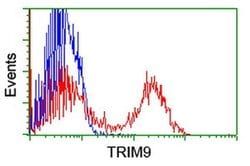
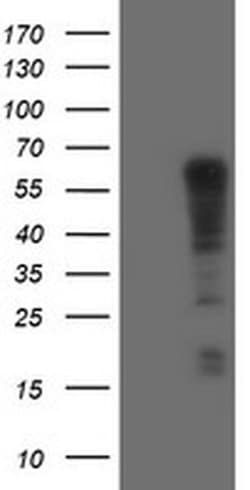
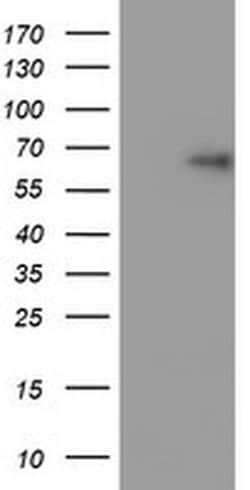

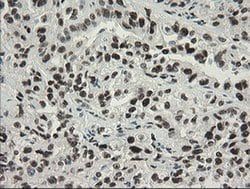
Description
- TRIM9 is a member of the tripartite motif (TRIM) family
- The TRIM motif includes three zinc-binding domains, a RING, a B-box type 1 and a B-box type 2, and a coiled-coil region
- The protein localizes to cytoplasmic bodies
- Its function has not been identified
- Alternate splicing of this gene generates two transcript variants encoding different isoforms.The protein encoded by this gene is a member of the tripartite motif (TRIM) family
- The TRIM motif includes three zinc-binding domains, a RING, a B-box type 1 and a B-box type 2, and a coiled-coil region
- The protein localizes to cytoplasmic bodies
- Its function has not been identified
- Alternate splicing of this gene generates two transcript variants encoding different isoforms.