50-168-58
CD7 Monoclonal Antibody (eBio124-1D1 (124-1D1)), Alexa Fluor™ 700, eBioscience™, Invitrogen™
Manufacturer: Invitrogen
Select a Size
| Pack Size | SKU | Availability | Price |
|---|---|---|---|
| Each of 1 | 50-168-58-Each-of-1 | In Stock | ₹ 30,082.00 |
50-168-58 - Each of 1
In Stock
Quantity
1
Base Price: ₹ 30,082.00
GST (18%): ₹ 5,414.76
Total Price: ₹ 35,496.76
Antigen
CD7
Classification
Monoclonal
Concentration
5 μL/Test
Formulation
PBS with 0.2% BSA and 0.09% sodium azide; pH 7.2
Gene Accession No.
P09564
Gene Symbols
CD7
Purification Method
Affinity chromatography
Regulatory Status
RUO
Gene ID (Entrez)
924
Content And Storage
4° C, store in dark, DO NOT FREEZE!
Form
Liquid
Applications
Flow Cytometry
Clone
eBio124-1D1 (124-1D1)
Conjugate
Alexa Fluor 700
Gene
CD7
Gene Alias
Cd7; CD7 antigen; CD7 antigen (p41); Cd7 molecule; GP40; LEU-9; p41 protein; T-cell antigen CD7; T-cell leukemia antigen; T-cell surface antigen Leu-9; Tp40; TP41
Host Species
Mouse
Quantity
100 Tests
Primary or Secondary
Primary
Target Species
Human
Product Type
Antibody
Isotype
IgG1 κ
Related Products


Description
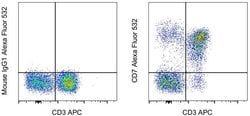
- Description: The eBio124-1D1 monoclonal antibody reacts with human CD7, also known as gp40 and Leu9
- CD7, a 40 kD receptor, is a member of the immunoglobulin gene superfamily
- The N-terminal amino acid sequence (aa1-107) is highly homologous to Ig kappa light chain sequence; while the carboxyl-terminal region of the extracellular domain is proline-rich and has been postulated to form a stalk from which the Ig domain projects
- CD7 is expressed on the majority of immature and mature T lymphocytes, and T cell leukemias
- It is also found on natural killer cells, a small suppopulation of normal B cells and on maligant B cells
- Cross-linking surface CD7 positively modulates T cell and NK cell activity, as measured by calcium flux, expression of adhesion molecules, cytokine secretion and proliferation
- CD7 associates directly with phosphoinositol 3'-kinase
- CD7 ligation induces production of D-3 phosphoinositides and tyrosine phosphorylation
- A clonogenic subpopulation of human CD34(+) CD38(-) cord blood cells that express CD45RA and HLA-DR and high levels of the CD7 has been reported
- These cells possess the capacity for lymphopoiesis
- They can generate B-cells, natural killer cells, and dendritic cells but do not possess the capacity to develop into myeloid cells or erythroid cells
- The CD7(+) phenotype distinguishes primitive human lymphoid progenitors from pluripotent stem cells
- CD7 (gp40, Leu9) is a 40 kDa member of the immunoglobulin gene superfamily
- CD7 contains N-terminal amino acids 1-107 are highly homologous to Ig kappa-L chains whereas the carboxy-terminal region of the extracellular domain is proline-rich and has been postulated to form a stalk from which the Ig domain projects
- CD7 is expressed on the majority of immature and mature T-lymphocytes, and T cell leukemia
- Further, CD7 is also found on natural killer cells, a small subpopulation of normal B cells and on malignant B cells
- Cross-linking surface CD7 positively modulates T cell and NK cell activity as measured by calcium fluxes, expression of adhesion molecules, cytokine secretion and proliferation
- CD7 associates directly with phosphoinositol 3'-kinase
- CD7 ligation induces production of D-3 phosphoinositides and tyrosine phosphorylation
- Expression of CD7 is an important marker used in leukemia diagnostics.