PPIG Rabbit anti-Human, Polyclonal, Bioss
Manufacturer: Bioss
Select a Size
| Pack Size | SKU | Availability | Price |
|---|---|---|---|
| Each of 1 | 50-198-5478-Each-of-1 | In Stock | ₹ 38,381.25 |
50-198-5478 - Each of 1
In Stock
Quantity
1
Base Price: ₹ 38,381.25
GST (18%): ₹ 6,908.625
Total Price: ₹ 45,289.875
Antigen
PPIG
Classification
Polyclonal
Conjugate
Unconjugated
Gene
PPIG
Gene Alias
AU019516; AU022200; B230312B02Rik; BOS_1662; CARS-cyclophilin; CARS-Cyp; CASP10; Clk-associating RS-cyclophilin; Cyclophilin G; CYP; LOC100341939; Matrin cyclophilin; matrin cyclophilin (matrin-cyp); Matrin-cyp; MGC133241; OTTHUMP00000204761; OTTHUMP00000204762; Peptidyl-prolyl cis-trans isomerase G; peptidylprolyl isomerase G; peptidyl-prolyl isomerase G; peptidylprolyl isomerase G (cyclophilin G); peptidyl-prolyl isomerase G (cyclophilin G); peptidylprolyl isomerase G-like; PPIase G; PPIG; Rotamase G; SCAF10; SR-cyclophilin; SRCyp; SR-cyp; SR-related CTD-associated factor 10
Host Species
Rabbit
Purification Method
Protein A
Regulatory Status
RUO
Gene ID (Entrez)
9360
Content And Storage
-20°C
Form
Liquid
Applications
Immunofluorescence, Immunohistochemistry (Paraffin)
Concentration
1 μg/mL
Formulation
PBS with 1% BSA, 50% glycerol and 0.09% sodium azide; pH
Gene Accession No.
Q13427
Gene Symbols
PPIG
Immunogen
KLH conjugated synthetic peptide derived from human PPIG.
Quantity
100 μL
Primary or Secondary
Primary
Target Species
Human
Product Type
Antibody
Isotype
IgG
Related Products
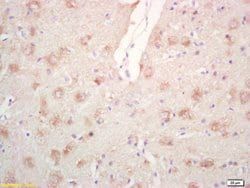


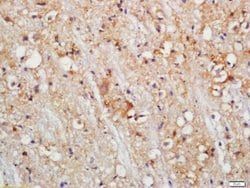
Description
- Structural Maintenance of Chromosomes (SMC) family proteins play critical roles in various nuclear events that require structural changes of chromosomes, including mitotic chromosome organization, DNA recombination and repair and global transcriptional repression
- The chromo proteins are conserved in eukaryotes and lead to mitotic chromosome segregation defects
- This suggests a critical function of SMC family proteins in mitotic chromosome dynamics
- SMC1 and SMC3 form a heterodimeric complex required for metaphase progression in mitotic cells
- Specifically this SMC1/SMC3 complex is responsible for sister chromatid cohesion during metaphase
- Mutations in the gene can lead to Cornelia de Lange syndrome 2.