Phospho-Proteasome 20S beta 7Ser214 (Ser214) Rabbit anti-Human, Polyclonal, Bioss
Manufacturer: Bioss
Select a Size
| Pack Size | SKU | Availability | Price |
|---|---|---|---|
| Each of 1 | 50-198-9015-Each-of-1 | In Stock | ₹ 38,381.25 |
50-198-9015 - Each of 1
In Stock
Quantity
1
Base Price: ₹ 38,381.25
GST (18%): ₹ 6,908.625
Total Price: ₹ 45,289.875
Antigen
Phospho-Proteasome 20S beta 7Ser214 (Ser214)
Classification
Polyclonal
Conjugate
Unconjugated
Gene
PSMA7
Gene Alias
C6; C6-I; epididymis secretory protein Li 276; HEL-S-276; HSPC; proteasome (prosome, macropain) subunit, alpha type 7; proteasome (prosome, macropain) subunit, alpha type, 7; proteasome subunit alpha 4; proteasome subunit alpha 7; Proteasome subunit alpha type-7; Proteasome subunit RC6-1; Proteasome subunit XAPC7; Psma7; RC6-1; RP5-1005F21.4; testicular tissue protein Li 151; XAPC7
Host Species
Rabbit
Purification Method
Protein A
Regulatory Status
RUO
Gene ID (Entrez)
5688
Content And Storage
-20°C
Form
Liquid
Applications
Immunofluorescence, Immunohistochemistry (Paraffin), Western Blot
Concentration
1 μg/mL
Formulation
PBS with 1% BSA, 50% glycerol and 0.09% sodium azide; pH
Gene Accession No.
O14818
Gene Symbols
PSMA7
Immunogen
KLH conjugated synthetic phosphopeptide derived from human Proteasome 20S beta 7 around the phosphorylation site of Ser214.
Quantity
100 μL
Primary or Secondary
Primary
Target Species
Human
Product Type
Antibody
Isotype
IgG
Related Products


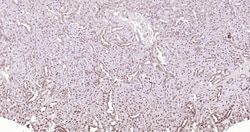
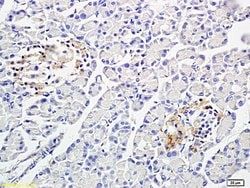

Description
- Component of the 20S core proteasome complex involved in the proteolytic degradation of most intracellular proteins
- This complex plays numerous essential roles within the cell by associating with different regulatory particles
- Associated with two 19S regulatory particles, forms the 26S proteasome and thus participates in the ATP-dependent degradation of ubiquitinated proteins
- The 26S proteasome plays a key role in the maintenance of protein homeostasis by removing misfolded or damaged proteins that could impair cellular functions, and by removing proteins whose functions are no longer required
- Associated with the PA200 or PA28, the 20S proteasome mediates ubiquitin-independent protein degradation
- This type of proteolysis is required in several pathways including spermatogenesis (20S-PA200 complex) or generation of a subset of MHC class I-presented antigenic peptides (20S-PA28 complex)
- Inhibits the transactivation function of HIF-1A under both normoxic and hypoxia-mimicking conditions
- The interaction with EMAP2 increases the proteasome-mediated HIF-1A degradation under the hypoxic conditions
- Plays a role in hepatitis C virus internal ribosome entry site-mediated translation
- Mediates nuclear translocation of the androgen receptor (AR) and thereby enhances androgen-mediated transactivation.