CCL4 Polyclonal Antibody, Biotin, PeproTech®, Invitrogen™
Manufacturer: Fischer Scientific
Select a Size
| Pack Size | SKU | Availability | Price |
|---|---|---|---|
| Each of 1 | 50-271-8605-Each-of-1 | In Stock | ₹ 1,75,552.50 |
50-271-8605 - Each of 1
In Stock
Quantity
1
Base Price: ₹ 1,75,552.50
GST (18%): ₹ 31,599.45
Total Price: ₹ 2,07,151.95
Antigen
CCL4
Classification
Polyclonal
Conjugate
Biotin
Gene
CCL4
Gene Alias
ACT2; ACT-2; AT744.1; CC chemokine ligand 4; C-C motif chemokine 4; C-C motif chemokine ligand 4; Ccl4; chemokine (C-C motif) ligand 4; G-26; G-26 T-lymphocyte-secreted protein; HC21; immune activation gene 2; immune activation gene-2; immune activation protein 2; LAG1; LAG-1; Lymphocyte activation gene 1 protein; macrophage inflammatory protein 1-beta; macrophage inflammatory protein-1 beta; MGC104418; MGC126025; MGC126026; MIP-1 beta; MIP1b; MIP-1B; Mip1-b; MIP1B1; MIP1beta; MIP-1BETA; MIP-1-beta; MIP1-beta; MIP-1-beta(1-69); MIP-1-beta(3-69); PAT 744; Protein H400; putative MIP-1beta protein; RP23-320E6.8; SCY4A; SCYA2; Scya4; secreted protein G-26; SIS-gamma; small inducible cytokine A4; small inducible cytokine A4 (homologous to mouse Mip-1b); small-inducible cytokine A4; T-cell activation protein 2
Host Species
Rabbit
Purification Method
Antigen affinity chromatography
Regulatory Status
RUO
Gene ID (Entrez)
20303
Content And Storage
-20°C
Isotype
IgG
Applications
Western Blot, ELISA
Concentration
0.1-1.0 mg/mL
Formulation
PBS with no preservative
Gene Accession No.
P14097
Gene Symbols
CCL4
Immunogen
E.coli-derived Recombinant Murine MIP-1beta (CCL4)
Quantity
500μg
Primary or Secondary
Primary
Target Species
Mouse
Form
Lyophilized
Related Products


Description
- AA Sequence of recombinant protein: APMGSDPPTS CCFSYTSRQL HRSFVMDYYE TSSLCSKPAV VFLTKRGRQI CANPSEPWVT EYMSDLELN
- Preparation: Produced from sera of rabbits immunized with highly pure Recombinant Murine MIP-1beta (CCL4)
- Anti-Murine MIP-1beta (CCL4)-specific antibody was purified by affinity chromatography and then biotinylated
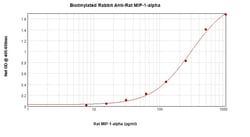
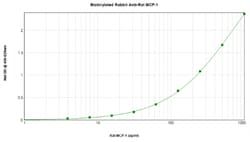
- Sandwich ELISA: To detect Murine MIP-1beta by sandwich ELISA (using 100 μL/well antibody solution) a concentration of 0.25-1.0 μg/mL of this antibody is required
- This biotinylated polyclonal antibody, in conjunction with PeproTech Polyclonal Anti-Murine MIP-1beta (500-P213) as a capture antibody, allows the detection of at least 0.2-0.4 ng/well of Recombinant Murine MIP-1beta
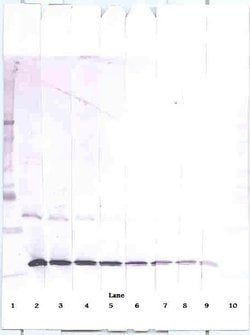
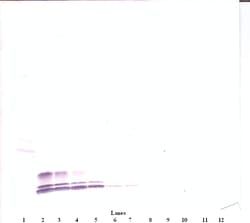
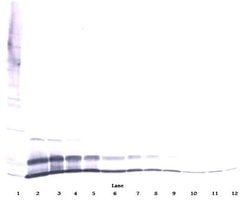
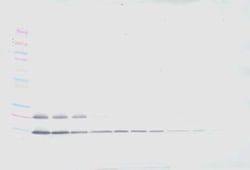
- Western Blot: To detect Murine MIP-1beta by Western Blot analysis this antibody can be used at a concentration of 0.1-0.2 μg/mL
- When used in conjunction with compatible secondary reagents, the detection limit for Recombinant Murine MIP-1beta is 1.5-3.0 ng/lane, under either reducing or non-reducing conditions
- 500-P213BT-1MG will be provided as 2 x 500 μg CCL4 (macrophage inflammatory protein 1-beta, MIP1B) belongs to the intercrine beta (chemokine CC) family
- Functionally, CCL4 is involved in chemotactic and proinflammatory effects, and homeostasis
- CCL4 is produced by macrophages upon stimulation by bacterial endotoxins
- CCL4 recruits and stimulates various inflammatory cells at sites of inflammation
- CCL4 is produced by lymphocytes, macrophages and dendritic cells
- Both CCL4 and the related protein CCL3 participate in the host response to invading bacterial, viral, parasite and fungal pathogens by regulating the trafficking and activation state of selected subgroups of inflammatory cells
- While both CCL4 and CCL3 exert similar effects on monocytes, their effect on lymphocytes differ, with CCL4 selectively attracting CD4+ lymphocytes and CCL3 selectively attracting CD8+ lymphocytes
- Additionally, both have been shown to be potent chemoattractants for B cells, eosinophils and dendritic cells
- The processed form of CCL4 can induce down-modulation of surface expression of the chemokine receptor CCR5, thus inhibiting the CCR5-mediated entry of HIV-1 in T cells
- CCL4 binds with high affinity to CCR5 receptors.